Showing posts with label york festival of ideas. Show all posts

Friday, 2 May 2025

York Festival of Ideas 2025: The Delights of Football


  • Saturday 7 June 2025, 3.15pm to 4.15pm
  • Location: In-person only at Ron Cooke Hub, Campus East, University of York (Map)Admission:
  • Free admission, booking required

Book tickets

From sportswashing to ticket prices, we hear much that is critical about modern football - but what remains magic about the game? From the beauty of floodlights to the glorious moment when a referee falls over, Daniel Gray, author of the Delights series of football books and owner of a Bootham Crescent turnstile, lyrically celebrates the simple joys of the beautiful game.

Join in the conversation at an event hosted by York’s Soccer-Mad Boffins Alex Gillett and Kevin Tennent of the University of York.

Daniel Gray is the author of the Delights series of football books, Stramash and Homage to Caledonia. For a short period in the early 1990s he was the finest left-back in his village, once marking Gordon Strachan’s youngest son (the one who didn’t become a footballer) out of the game. A Middlesbrough supporter, Daniel began attending football matches in 1988 and has never recovered. He has worked in a psychiatric hospital, a library and in television and politics.

Friday, 16 June 2023

York Festival of Ideas 2023

On Saturday 10th June 2023, The Soccer Mad Boffins chaired two author discussions at the University of York Festival of Ideas. Or at least we were supposed to, but due to ill health Kevin had to withdraw his involvement at the last minute. So, Alex stepped up to chair both talks on his own, although Kevin had contributed equally to the proposals, planning, and preparing lists of questions.

The first talk extended the Soccer Mad Boffins into cricket. Dr Duncan Stone discussed his recent book 'Different Class: The Untold Story of English Cricket' (Repeater Books, paperback ISBN: 9781913462802) which explores the governance of cricket and impact of social class rigidity.  It also raises questions about outreach, public relations, and 'marketing' of the game to participants and to fans, and Duncan suggested ways to re-imagine the cricket sport 'product' that he believes would help it to become a 'people's game'.

The second talk was with Dr Alexander Jackson of the National Football Museum. He discussed his latest book 'Football's Great War: Association Football on the English Home Front, 1914 1918' (Pen and Sword, Hardback, ISBN 1399002201). Discussion then turned to the National Football museum, and curating sensitive content such as war, as well as the less sensitive topic of current and upcoming exhibitions at the museum, which is definitely worth visiting. An interesting point was how football was used to recruit players and fans to the war effort, how finances were managed to keep clubs in business, the ethics of sustaining sport during war, and how football managed its public relations and its communications/messaging during this difficult time, to it supporters, with examples of advertising from the museum's collection.

Both talks were well attended with lots of great questions from the audience in addition to those asked by Alex.

Afterwards both authors signed many copies of their books for eager attendees.

Thank you to all involved with organising and operating the Festival and for making it the amazing annual fixture that it is.

You can watch the videos of both talks free of charge using the below links;

Duncan Stone - 'different class'

Alex Jackson of National Football Museum - 'Curating the world's game - football's Great War'


Tuesday, 22 June 2021

York Festival of Ideas 2021: The Soccer Mad Boffins & Keith Hackett


We at SOCCERMADBOFFINS were delighted to participate again in the University of York Festival of Ideas.

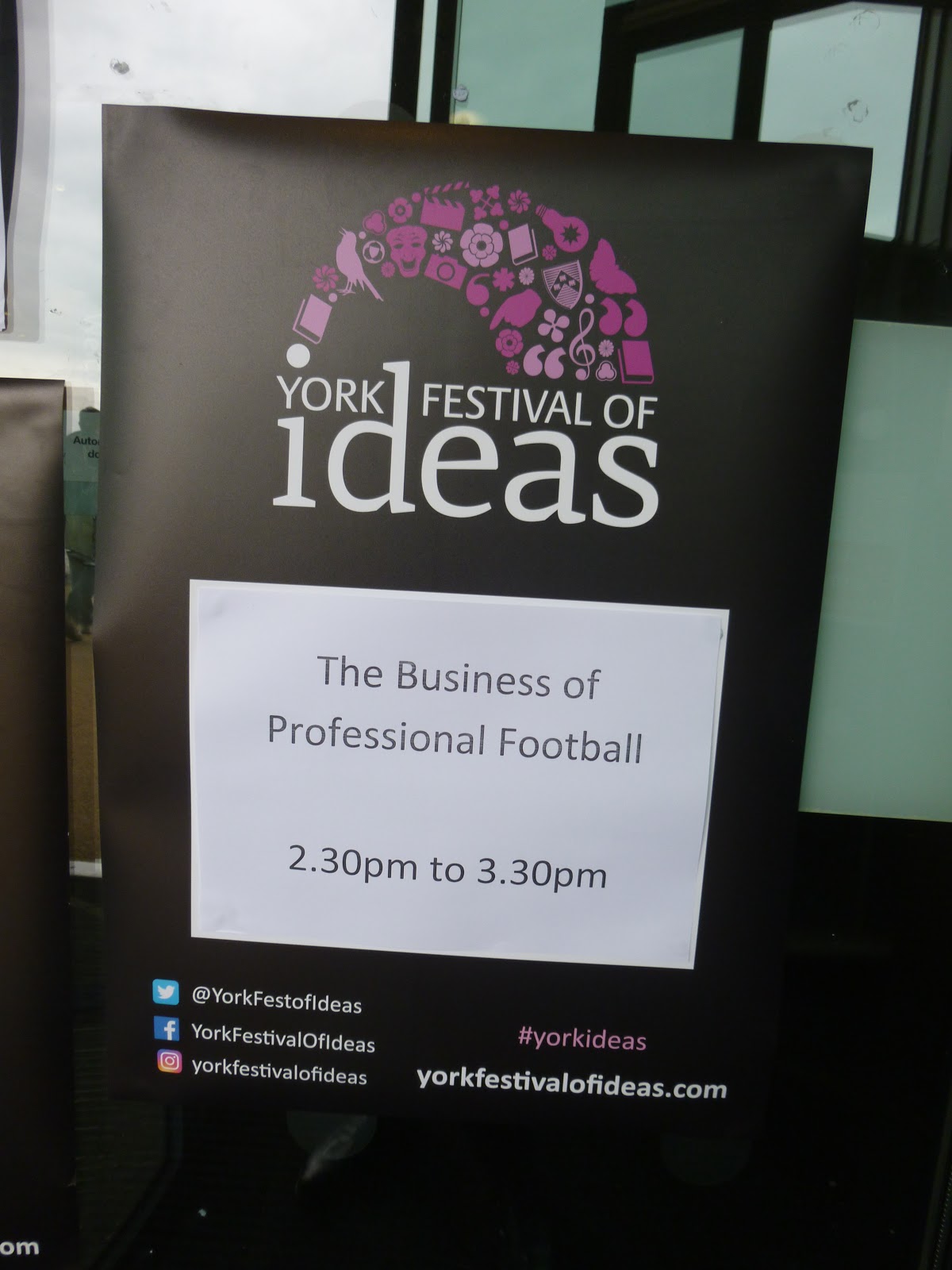
Firstly, we hosted an online "ask the experts" session about 'The business of professional football' with the recent aborted idea of a European Super League the liveliest subject. We received many great questions and it was even suggested to us that we could take the event on tour!

Our main contribution, and one of THE key events of the entire festival, was hosting a presentation and conversation session with former high-profile FIFA listed football referee Keith Hackett about football's historic roots in Yorkshire, the evolution of the laws of the game, and personal reflections on his career and on football refereeing today.

The event with Keith entitled "Rules of the Game: On and off the pitch" is now available on YouTube, and can be viewed below.

Towards the end of the session we had so many questions from the audience that we ran out of time to include them all. Keith very kindly agreed to answer each question via email and that is included below the video (if it says 'video unavailable' just click on black box and it will direct you straight to it on Youtube):


Extra Q&A Questions:


We are rated as a very vocal group of fans and as such put a huge amount of pressure on referees so are there any plans to improve mental health in referees not just physical health?


KH: "When I took over the management of the Professional Game Match Officials Ltd, I introduced top Sports Psychologist Prof Craig Mahoney. He was superb working with the group of professional referees in group and face to face individual sessions. 

He sat in the Technical Area at some of the games in order to get a clear understanding of the pressures on match officials.  He looked at how he could help with reducing the pressure on match officials. One aspect was stadium familiarity so we appointed new officials onto the list to fourth official duty before sending them to referee.

He improved their interpersonal and communication skills. Body language and enhancing their ‘presence’ on the field of play.  Goal and target setting, keeping a diary and many other aspects, Prof Ian Maynard from Sheffield Hallam University then took over the role."


Referees never stop during a game, what is the physical training like? Do they train as players to keep up?

KH: "Referees in a Premier League game will on average cover a distance of 11500 meters in a game. A minimum of 1000 meters is at a speed of 7 meters per second. 

I employed two full time Sports Scientist. The first was Prof Matt Weston who embarked on a strategy of creating a lifestyle change in our match officials. He would issue various training schedules usually four a week taking into account games over the weekend and mid-week. High intensity, Recovery, etc. We also introduced pre-game warm ups for referees in order to avoid injury.  The second Sports Scientist would concentrate on CORE again to reduce injuries.

Incidentally I provided match officials with Polar Heart Monitors so that each of these training sessions was recorded and then downloaded after each session to the Sports Scientist.

Prozone recorded the movement profiles of the referees and I showed that slide in my presentation."


What have been the most physically challenging games that you have been involved with?

KH: "In the early eighties I was appointed to the FIFA U23 World Cup which tool place in Mexico. 
I officiated in Guadalajara USA V Russia, In Lyon. Holland V Brazil and at 5000 – 7000 feet above sea level 
These games were physically demanding. We were amateur referees with no guidance on the appropriate training sessions etc.

I also officiated many FA Challenge cup semi finals which were usually played at high intensity speed levels,

Many physical encounters including the Battle of Old Trafford where a twenty one men brawl took place. Both teams were deducted points the first and only time that this has happened.
.
With a very high pitvhed whistle been used by a traffic cop. This event took place on Day 2 of the UEFA Euro Championship. Having officiated in the opening fixture of the Euros yourself, what are your memories, what does the pressure feel like and how did you prepare?

I was appointed to the opening game of Euro 88 West Germany v Italy and flew into Dusseldorf with my two linesmen (Asst Refs) both FIFA International referees Neil Midgley and Brian Hill, Our preparation was to officiate three Football League games together. We then flew into Dusseldorf two days before the game, officiated the match and then returned home.

No training camps, no debate on our perforances. We also were made aware that we would only be officiating one game.

Danny Makkelie the 2020 opening game Italy v Turkey referee will have attended several training camps and along with eighteen other referees and twenty two VAR operators are based in Nyon, Geneva, they will be reviewing games, and been trained daily with the aid of Sports Scientists."


Have you ever lost the pea from your whistle?

KH: "I started off using an ACME THUNDERER WHISTLE but prior to officiating Inter Milan I was doing some sight seeing in the City centre and was taken aback with a very high pitched whistle that she was using. I made enquires and learned that it was an Italian Balilla whistle we then approached the officer in the centre of the road and my interpreter arranged for me to acquire one after he visited the local police station.I used this for the rest of my career.
Most Premier League referees now use a pealess FOX 40."


You spent some time officiating in the NASL. The NASL is known for having introduced some 'local' laws and presentational aspects to the game. These appear to have been partly down to practical situation (i.e., playing on narrow fields originally designed for American Football) and some to do with the expectations of the US sports consumer and advertisers, i.e., not keen on the idea of a 0-0 draw. What are your memories and reflections of that time? 

KH: "In 1981 I was invited to referee on the NORTH AMERICAN SOCCER LEAGUE which I readily accepted knowing that the experience of refereeing 24 games in an eight-week period would accelerate my career.

My base was the famous Waldorf Astoria, New York City but within hours of landing and securing my green ticket I was handed a folder full of airline tickets: Tampa Bay Rowdies (Florida) Vancouver Whitecaps, New York Cosmos, Tulsa, Portland, San Jose, Chicago Sting were posted on the roster of the first sheet.

My referees kit was provided and typical of American sport on the back I had the number 8, Guest Referee, my first game was Rowdies v Fort Lauderdale. I was driven onto the field in a Police car and the speakers announced has I got out of the car that I was Guest Referee Keeeeeeith Haaaackett all the way from England.  I gave a wave and then stood at the centre of the field whilst both teams were introduced one by one as, they ran out onto the pitch. It went something like, “Playing number 10, with 15 goals and three Assists we have former England International and Rowdies favourite player Rodney Marsh." I had received instructions that during each half I had to arrange two one-minute stoppages so that television could play appropriate ad breaks. I learned quickly that when I was going to apply a stoppage I would run to a player on the ground and instruct him to stay on the ground, calling for the Physio to come on and treat. With my arms above my head a would cross them to inform the independent timekeeper to stop the clock for 60 seconds.  After the 60 seconds the television crew standing at the side of the pitch would give me the signal to say the 60 seconds was up. A strong whistle then got the game underway.

Some of the games were played in Baseball and American Football Stadiums with Chicago’s Wrigley Field and New York Cosmo Giants Stadium remembered with fondness.

I had different pieces of law that the Americans applied to their competition which were not supported by FIFA:

OFFSIDE

The penalty area front line was extended across to each touchline and offside could only be flagged in that part of the field of play.  I remain supportive of that because there appeared to be less offside decisions and more excitement has wingers often gained possession of the ball inside their own half of the field of play and made dashing runs down the wings.

PENALTY SHOOT OUT TO DETERMINE THE WINNER OF THE MATCH

The field markings had a line in each half 35 yards away from the goal line. A countdown clock would be positioned close to the starting point of the player taking the penalty kick, The goalkeeper was positioned on the goal line. When I blew the whistle the attacker started to run with the ball. The goalkeeper could now run off his line to defend his goal or even make a challenge for the ball. The player taking the kick had to get his shot off within 5 seconds. Interestingly I loved it and of course no game could end in a draw. When the MLS was formed they operated the same shoot out procedure but later withdrew it

There were of course a variety of International players from Europe and South America across most of the teams, I recall on one game heading for Giants Stadium stuck in traffic in Lincoln Tunnel. The cab driver recognised someone who was running with a pair of soccer boots in his hands. He wound down the window and shouted for the runner to get in the cab. It was Carlos Alberto the Brazil team captain who a few years earlier had lifted the famous World Cup Trophy. The cab driver explained that I was the ref for the game.

We shook hands, smiled and with a couple of hundred yards to get to the Stadium entrance I jumped out of the cab and walked the rest of the way. 

In that game I produced an early yellow card to the Cosmo number nine who responded by shouting and standing like a Toreador, “Do you know who I am, no I said, but I do need your name, I am the famous GEORGIO CHINAGLIA.” He was not happy and uttered a few swear words has he walked away. 

After the game he came to my dressing room and I was expecting him to have a go at me. To my amazement he asked if I would give him my yellow card. I handed it over and he shouted “You crazy Englishmen, no one shows Georgio a yellow card. Playing that day alongside Carlos Alberto was Franz Beckenbaur and Julio Cesar Romero. Paraguay International.."


Thank you Keith for giving the talk and for taking the time to answer these questions

Wednesday, 28 August 2019

Financial Troubles at Football Clubs: York Festival of Ideas, and the cases of Middlesbrough, Bury and Bolton


Back in June it was our great privilege to present our research at York festival of Ideas.

We were involved with two sessions - the first, Chaired by Kevin, was a highly insightful presentation by Daniel Geey - a legal/business expert with significant experience in the football industry and has worked on a variety of club takeovers, high profile transfers, commercial endorsement deals and disputes. His talk centered around his book and was entitled 'Done Deal: Premier League Big Business' and generated much discussion from the audience about players, their agents, and tax issues - and some were also interested by the ethical implications that can arise. Thanks Daniel for a truly insightful presentation.


Next, we were both in conversation with best-selling investigative journalist and author, David Conn.


The event was notable for several reasons.

Firstly it was a first public appearence by Alex after experiencing serious illness earlier this year. Although he sat down for most of the event, getting out and in front of an audience was a big step forward in his recovery.

Secondly, sharing the 'stage' with David Conn was a real accomplishment.  On a personal level it was great to talk to him about our research, which has drawn on some of the facts an  ideas outlined in his books, particularly 'The Beautiful Game: Searching for the Soul of Football'.  Coincidently we were also undertaking our own research of the World Cup (and related to that, the history of FIFA) at around the same time as David was doing his own research, albeit more concerned with criticisms of the organization in its more recent form, and ultimately published in his 2017 book ''The Fall of the House of FIFA'.  


The talk began by Kevin outlining the work we have published, particularly the ideas of Shadow Hybridity and the Institutional Logic of Professional Sport, as outlined in our recent paper featured in Journal of Management History: 

Final published version (look it up via your university library): click here 

Accepted penultimate draft (unformatted document, freely available with no paywall): click here

Alex and Kevin then made links between our theories and the ideas presented in David's books about finance in football, and contrasting cash-strapped lower league teams, such as Middlesbrough in the mid-1980s with, premiership today's giants such as Manchester City and the concentration of wealth resulting in ever widening gaps between them and many teams of the lower leagues.

David responded passionately with detailed answers - he really cares about the subject matter - and has researched it thoroughly.

The things that we talked about that day struck a chord with the audience, many of whom had question and insightful comments to make about their own perceptions and experiences as fans.  

As some of you reading the will know, David Conn is a former student of University of York, the venue and a main organizer for the festival of Ideas.  After the event we took David for a walk around his old campus and enjoyed talking about the place.  Thanks David and also thanks to everyone at the Festival of Ideas team and the University of York for hosting our event, and to everyone who attended on the day for being a brilliant audience. Both of the football talks were free to attend but fully booked, so see you again next year, we hope, but book early!


David Conn revisits University of York (photo credit: Alex Gillett)


                                                                           ******


Reflections on Today's News

The last couple of days have brought these issues back into focus and our ideas about the institutional logic of professional sport have never seemed more pertinent, with Bury today being expelled from the league and Bolton Wanderers hanging on by a thread.  Two clubs with much history, including famous FA Cup wins.  

As Bury and Bolton, once proud Lancashire towns, have been consumed Pac-Man like by the 'Greater Manchester' metropolitan area, their economies as well as their football clubs appear to have declined financially, if not always so on the pitch (Bury were only just promoted this summer and Bolton have for many years been a bit of a 'yo yo' team but tend to pivot around the second tier)- whilst those of the dominant geography (ie the city of Manchester) have experienced what seems to the outsider to be a concentration of inward investment, and glory (United and City are both now globally recognized brands- and City won a clean sweep of domestic honors last year). 

Even Salford, a former dockland area (in the shadow of Old Trafford in one direction and the National football Museum in another) but newly revived by the arrival of the BBC at 'Media City' in 2011, now have a team competing professionally in the English Football League.  

Salford City FC is  buoyed financially by a consortium ex-Manchester United players' who seemingly preferred to 'start from scratch' and begin a new generation by taking a non-league club (as it was when they invested) into the league (where it is now), rather than take on the baggage of an established local league club with an existing fan base, but also the weight of history and the albatross of debt.  

For example the Neville brothers (Phil and Gary) have a combined ownership stake in the Salford Club of 20% according to Wikipedia - whilst by way of contrast their mother Judy worked as Bury FCs club secretary until recently, and their late father was at one time on the Bury FC Board of Directors (according to the BBC).  

As we outline in our paper, fans want to win and professional football clubs demand more and more money in order to retain their professional status.  Without constant investment and the promise of 'being in with a chance of promotion/winning the cup' will eventually lead to many paying fans deserting in their droves, and also lead to extra expense from 'sacking' managers, player wages and fees etc, to attract talent in the hope of turning things around. Maintaining professional status in order to be narrow the odds of achieving glory, creating a 'buzz' and attracting sponsors and television money, to re-invest in more players and stadiums seems to be the cycle of events time and again - only for some clubs that cycle becomes a death spiral, particularly if owners' laden more debts onto the club, for example by diversifying into sports halls/public gyms, hotels, or to subsidize some of their other business interests. 

We wish Bury and Bolton the very best of luck for the future, and hope that the precedents set by others such as Middlesbrough (which escaped by the skin of their teeth in 1986), and Accrington Stanley (which reformed after leaving the league in the 1960s - eventually returning in 2006 and now comfortably placed in League 1.)  

More closely to home we also hope that York City can capitalize on their strong start to the season and climb back up the pyramid soon.  It has been a turbulent few years for York and it would be great to eventually have League football at the new stadium when it is eventually opened.


Wednesday, 27 June 2018

Are you looking forward to England's World Cup game this evening?

Hoping for a repeat of 1966 in 2018?

Looking for something to listen to while you wait for your next fix of televised football?

Remember we have a FREE podcast all about the history of football and the world cup, with an emphasis on the 1966 tournament:

https://soundcloud.com/the-story-of-things/two-the-story-of-football

Also on itunes!


Tuesday, 5 June 2018

FREE SOCCER MAD BOFFINS PODCAST


The university of York and York Festival of Ideas have released their new 'Story of Things' podcast series.  which includes an episode by Dr Kevin D. Tennent and Dr Alex G. Gillett (aka The Soccer Mad Boffins) and Dr Alex Jackson (from the National Football Museum, England).

Indeed, the series promises a broad and fascinating selection of podcasts.  According to a spokesperson for University of York "Archaeologist, Dr Penny Spikins returns for a second series of The Story of Things podcast, where she is exploring research projects in sporting events, voice recognition, bee conservation, and how the police force are tackling issues of mental health".

Download the podcast for free using this link:

Itunes: https://itunes.apple.com/gb/podcast/the-story-of-things/id1246158465?mt=2

Soundcloud: https://soundcloud.com/the-story-of-things


Produced by Philippa Geering of Overtone Productions,our episode entitled 'The Story of Football' clocks in at around 18 minutes and focuses on the FIFA World Cup as a sport mega-event. We focus in particular ion the 1966 FIFA World Cup, and contextualize it by talking the listener though football history more generally, ideas about sport mega-events as mega-projects and their associated opportunities and threats.  We also visit the National Football Museum and Old Trafford Stadium in Manchester, and join some University of York students for a game of football.


L-R: Philippa Geering (Overtone Productions) interviews Dr Alex Jackson (National Football Museum), Dr Alex G. Gillett andDr Kevin D. Tennent (Soccer Mad Boffins)


The podcast ties-in with our appearance at the York Festival of Ideas on June 12th, where we will give a talk entitled 'The Business of The World Cup' which will be chaired by the former Chairman of the Football Association, Greg Dyke.  Tickets are free but you must pre-book one to gain admittance on the evening: http://yorkfestivalofideas.com/2018/talks/business-world-cup-football/


Read more about the podcast series here:

https://www.york.ac.uk/news-and-events/features/2018/story-of-things-podcast-returns/


Read more about York Festival of Ideas here:

http://yorkfestivalofideas.com/2018/