Monday, 27 June 2016

Launch of the 1966 World Cup Exhibition

A recent and exciting project for The Soccer Mad Boffins team has been to collaborate with our friends at the National Football Museum (NFM) in Manchester, England, on an exhibition celebrating the 1966 FIFA World Cup which was hosted and won by England.


"With stories from the people who made the games, played the games and watched the games that made the 1966 World Cup such an iconic tournament, the 1966 World Cup Exhibition celebrates England’s success and looks at the legacy of that win."


On Friday 24th June, Dr Alex Gillett attended the launch event which was also the launch for the new International Football Walk of Fame, and included speeches and Q&A from the NFM, Greg Dyke (English Football Association and former Chancellor of University of York), former England stars Sir Bobby Charlton, Roger Hunt, Jimmy Armfield, Mike Summerbee, and the families of others such as Nobby Stiles.  Also in attendance were the Head of the German Football Association (Deutsche Fussball Bund, or DFB), 'You are the Ref' artist Paul Trevillion who gave an impromptu and passionate speech, David Courtney (songwriter, producer and President/CEO of the Football Walk of Fame) and referee Keith Hackett, amongst others.

In particular, Alex was very fortunate for a photo opportunity and conversation with two stars from Women's Football, Lesley Lloyd (ex-captain of the great Southampton Ladies team which dominated the women's FA Cup through the 1970s and early 1980s) and Sue Lopez (former star of England, Southampton, and Italian 'Serie A' team Roma).


Sue Lopez, Lesley Lloyd, Dr Alex Gillett


An inteteresting factiod for us here Soccer Mad Boffins is that Sue Lopez played for the England Ladies team during the time that it was coached by the great Martin Reagan, who during his own playing career enjoyed a spell at Middlesbrough FC at the same time as Alex's Grandad Giles Gillett.

All in all the event was a great success and we highly recommend that you visit the exhibition whilst it runs (25th June 2016 - 23 April 2017). There will be another version of the exhibition held at Wembley Stadium, London launching in July 2016 and we'll report back on that too when we've had chance to visit it.


Monday, 13 June 2016

EURO 2016: The luck of the Irish?

The UEFA EURO 2016 tournament has now kicked off in France.  Unusually, three UK home nations (and members of the International Football Association Board) have qualified for the finals this time - England, Wales, and Northern Ireland.  Even more unusually, perhaps, both teams from Ireland have qualified, as the Republic of Ireland are also in the finals, starting their campaign later on today against Sweden.  The issue of split football associations interests us here at soccer-mad-boffins, as it represents exceptions to usual the FIFA rule that one 'nation' must only be represented by one FA.  Apart from Ireland, splits were most common when nations were partitioned during the Cold War - North and South Korea, and China and Taiwan being prominent examples, along with East and West Germany, who famously met in Hamburg during the 1974 World Cup.  In the only finals appearance to date of two teams from partitioned countries, the East won 1-0, but the West would go on to win the competition.

Ireland's split was intriguing because the Northern Irish FA still calls itself the Irish Football Association, and both it and the Football Association of Ireland, formed just before partition in 1921 both fielded teams under the name 'Ireland' until the late 1940s.  Both teams still play in green, can call up players from both sides of the border (though they often play in English football), and are managed by an M. O' Neil; indeed both might legitimately represent Irish hopes of tournament success.  Any sense of animosity now seems to have subsided as both sets of fans were pictured partying together in Paris.  There is the possibility of Northern Ireland and the Republic meeting later in the tournament, perhaps in the Quarter Finals if both teams win their groups and the following second round matches although this now looks unlikely as Northern Ireland lost their opening match to Poland 1-0.  Any such meeting would only be the second between two partitioned nations in a major finals to our knowledge.  Helpfully, BBC Northern Ireland have produced a short video to encourage further confusion between the two teams, which is probably best viewed after a pint or two of McGrath's Irish Black Stout!

Monday, 6 June 2016

Senate House Symposium: Some Highlights

The 'More than Just a Game: The legacy of the 1966 Football World Cup' symposium, held at Senate House on Friday 3rd June proved an enjoyable day with many interesting new insights into the 1966 tournament and its longer term impacts emerging.  The day was well attended by sports historians and other interested parties, and organised by Leslie Crang, a student on the MSc Sport Management & the Business of Football programme at Birkbeck College, London, together with Emily Stidston, Senate House's Engagement Support Officer.

Before Kevin's presentation the day was kicked off by Prof John Hughson from UCLAN, in Preston, who showcased the research from his new book7 on the cultural aspects of the 1966 World Cup.  In an intriguing talk Hughson commented on portrayals of the competition on film, from an episode of the Rank Organization's Look at Life documentary series, to FIFA's official film of the tournament, Goal!, and also Alf Garnett and his son in law Mike attending the 1966 Final in the film version of the BBC sitcom Til Death us do Part.  In the afternoon Dr Christoph Wagner of De Montfort University presented his research on the impact of the World Cup on Anglo-German relations, with particular interest in German reactions to 'Das Wembley-Tor' and how the 1966 final was seen as something of a moral victory for both sides.  This was followed by Dr Stacey Pope of Durham University who has studied memories of the 1966 tournament of female football fans of Leicester, some of whom were already seasoned followers of Leicester City FC, but
for others the tournament, which reached record TV audiences, was their first experience of soccer.  Not surprisingly England's victory remained an important memory for many.  The final session saw Kevin join a panel discussion with the football historian and Guardian writer David Goldblatt, and Prof Kath Woodward of the Open University, in which the long term implications of the tournament for English identity were discussed; a major contention being that the English have lacked any real outlet for their patriotism apart from football, as perceptions of Englishness have drifted away from Britishness in the years following 1966.  After all, the Union Jack would never be seen as a representative emblem of the England football team today, as it is on the front cover of the Radio Times prior to the 1966 tournament as seen in our picture.

The symposium was very enjoyable and useful for us and we thank the organizers as well as the other speakers and the attendees for their feedback on our book, Foundations of Managing Sporting Events: Organizing the 1966 FIFA World Cup and contributions to the discussion.

Tuesday, 31 May 2016

Kevin to Appear at Senate House Symposium!

Kevin will be representing us at an academic symposium at the University of London's central library, Senate House, which is said to have inspired George Orwell's Ministry of Truth in the novel 1984, on Friday June 3rd.  The symposium focuses on the political, social, economic and cultural impact and legacy of the 1966 FIFA World Cup. Kevin will be talking about the financial and organisational findings from our forthcoming book; in particular how government support for the tournament had been crucial for the provincial venues, but also how the hoped for boost for Britain's tourist industries did not materialise as envisaged.

The symposium is free to attend and open to the public, starting at 9.30am.  Other attractions during the day will include a keynote by Professor John Ewing Hudson, Professor of Sport and Cultural Studies and Director of the International Football Institute at the University of Central Lancashire, a discussion on the impact of England's victory on Anglo-German relations by Dr Christoph Wagner of De Montfort University, a paper on women's experiences of the 1966 Finals by Dr Stacey Pope of Durham University, and a roundtable discussion with Dr Kath Woodward from the Open University and the football historian and Guardian journalist David Goldblatt, who will also be making the closing remarks.

It should be a very engaging and thought provoking day - further details and registration is here!

Friday, 20 May 2016

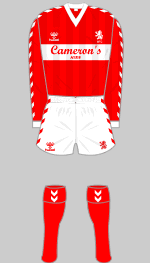
Beer and the Boro - A Perfect Match!

 middlesbrough 1985-86

If your university of library has access to Springerlink, you can easily download the digital edition of our new book chapter 'Beer and the Boro - A Perfect Match!'


"Although football clubs (FCs) as firms are relatively unsustainable from a purely financial perspective, the club brands appear highly sustainable in comparison with many other industries (Kuper and Szymanski, 2012). While the ownership and the companies running the clubs may change, the club brands themselves appear to be more stable than in other industries where firms and brands go out of business, relocate or diversify to a far greater extent (e.g. Hannah, 1997). This may be because they are less vulnerable to competition — FCs have historically been geographic, and while their catchment area may shrink during less successful periods, it will not disappear entirely. Furthermore, rival foreign clubs do not enter and supply soccer at lower prices (although foreign investors may bid to take over the ownership) and although English clubs as a whole could fall behind foreign competitors and lose their best players, foreign clubs have their own problems of finance and management (Kuper and Szymanski, 2012). Put succinctly, society can keep unprofitable clubs going cheaply: bank managers and tax collectors have historically appeared reluctant to close century-old clubs -and so society swallowed the losses. Perhaps clubs were and still are too small to fail. At the same time, the brand loyalty of supporters means that no matter how lousy the product, a hard core of customers will continue to purchase: “Soccer is more than just a business. No one has their ashes scattered down the aisle at Tesco” (Taylor, 1998, cited by Kuper and Szymanski, 2012, p.82)."


In the chapter, we discuss the relationship between the beer and brewing industry and football in the 1980s, through the case of Middlesbrough FC, a club which experienced severe financial challenges during the 1980s.

So what are you waiting for - have a read, put it on your reading lists, cite it in your research. You know what to do!


http://link.springer.com/chapter/10.1057%2F9781137466181_16

Thursday, 19 May 2016

Walking Football = good for your health

 http://previews.123rf.com/images/chudtsankov/chudtsankov1403/chudtsankov140300011/26378917-Smiling-Soccer-Ball-Cartoon-Character-Running-Illustration-Isolated-on-white-Stock-Vector.jpg

Whilst the professional game is fast-paced and physical, particularly here in the UK, participation in football can in fact be enjoyed by people of all ages and ability.

'Walking Football' is proposed as beneficial to mental health.  This short BBC news article looks into the proposed benefits of 'walking football' for older and depressed men.


http://www.bbc.co.uk/news/video_and_audio/headlines/36329589

Tuesday, 17 May 2016

World's Worst Groundsmen?


 http://newsimg.bbc.co.uk/media/images/40747000/gif/_40747002_footy_pitch_finale1.gif
(Image from http://newsimg.bbc.co.uk/media/images/40747000/gif/_40747002_footy_pitch_finale1.gif)


Creating the perfect football pitch requires several things, perhaps most obviously are good turf and the ability to produce precise markings.

Whilst a PhD in triganometry is not mandatory, the ability to paint straight lines onto the grass is pretty much a thresshold skill.

Except that is, in the seventh tier of Norwegian football, if British tabloid newspaper The Mirror is to be believed. Reporting on the wonky state of the white lines on the pitch for a recent fixture between Nordic minnows Julebygda and Riska 3, The Mirror writes "we're just amazed they managed to actually play a game through the inevitable fits of laughter..."

Have a look at the handiwork of groudsmen Quang Minh Ha and Nick Duy Do using the following weblink to see for yourself (photos included):

http://www.mirror.co.uk/sport/row-zed/worlds-worst-groundsmen-been-found-7983574#rlabs=1%20rt$sitewide%20p$10