Showing posts with label Middlesbrough FC. Show all posts

Tuesday, 14 February 2023

Boro Memories

Alex was the subject of the 'Boro Memories' three page interview in the match programme for the game between Middlesbrough and Blackpool, on February 4th 2023.

The game, in the Championship level of the English Football League, was attended by a crowd of 26,299 people.

The article, included below, included Alex's memories of being a fan from childhood and attending his first games in the 1980s, up to more recent times, via Boros cup run in 1990 which took them to a Wembley Final for the first time, and an 8-1 win again Manchester City in 2008.  Also included are never before shared photographs from Alex's personal collection taken with former manager (and current coach) Jonathan Woodgate and the legendary Bruce Rioch. Also mentioned was his recent with Dr Kevin D Tennent on the operations of the club in the 1980s and of the 1966 FIFA World Cup.

The interview for 'Boro Memories' was conducted by Dr Tosh Warwick, of Heritage Unlocked. Tosh says:

 "Boro Memories and collaborating with Middlesbrough FC offers a unique way to discover and showcase the often very personal history and heritage of football on Teesside in a variety of ways. Alex's contribution not only helped shed light on his own club memories but also helped share his valuable research on the 1966 World Cup and the operations of a football club with new audiences reading the matchday programme in the stands at the Riverside Stadium."


Thursday, 4 May 2017

Railways and 'the beautiful game' before 1914: football, fans and formalisation

The following article is 'reprinted' (with minor updates) from an original post by Dr David Turner on the website 'Turniprail' back in 2014. We thought it would be of interest to readers of Soccer Mad Boffins too:  


Recently I have been doing some work on how the railways of Britain influence the development of organised sport  before 1914 and most of my investigations have focussed on the ‘beautiful game’: football. Early forms of football, which used rules that may have borne only a passing similarity to those in the current game, was being played in public schools from the late eighteenth and early nineteenth century.[1] However, by the late-nineteenth and early-twentieth centuries going to a football match was on the nation’s favourite pastimes. The question I have therefore been asking is to what extent to were the railways a factor in transforming football (and while we are thinking about it rugby) from a ramshackle game into the popular spectator sport it is today? Were the railways a key factor because of the improved transportation they provided, or did other, non-railway factors play a role, for example urbanisation or increasing incomes and leisure time amongst working class individuals? This issue can be split into two parts. Firstly, to what degree did the railways augment the number of spectators going to matches? And, secondly, how did it change participation in the game? 

I’ll start by talking about how attendance at football matches was augmented by the railways. The traditional view was that the railways played a big role, and some have argued that the improved transport communications they brought widened the population’s access to sporting events generally. L. H. Curzon was a proponent of this idea. In 1892 he wrote ‘today the railways convey the masses in large numbers to the different seats of sport’.[2] Years later this view was echoed by scholars. Vamplew argued that that ‘railways revolutionised sport by widening the catchment area for spectators,’[3] while Simmons concurred, stating that they ‘contributed to the growth of spectator sports.’[4] While not directly mentioning football, these statements heavily imply that these academics believed that that the railways were a major factor in its development as a popular spectator sport after the 1870s.

Recently, however, this view fallen out of favour. Huggins and Tilson argue that the role of the railways in the growth of football spectatorship from the 1870s onwards has been overstated. Most supporters rarely ventured to away matches, except in the case of a local derby or an important cup tie. Indeed, the vast majority of fans travelled to local matches by foot and, from the 1890s, by electric tram.[5]David Goldblatt, a noted football historian, agreed, arguing that ‘apart from local derbies away fans were almost absent [from matches] during the’ whole of the period between 1880 and 1914.[6]  Exemplifying this, even when a special train accommodation was put on for away fans by the railway companies it was not well used. In 1886 Middlesbrough F.C. was to play Lincoln in an early round of the F.A. Cup. The railway provided a special saloon carriage for away fans, but only 200 excursionists travelled by it, which included the team and officials.[7] 

So why did football fans not travel to away matches that often? Primarily, it was because of economic and time constraints. Most did not have the money to travel to away matches, while in an era when many employed individuals worked on Saturday morning, they also lacked the time to traverse the hundreds of miles to an away fixture.[8] As such, there is a good case for saying that growth of football spectatorship after the 1870s, particularly amongst the working classes, was not because of the improved transportation the railways provided. Rather, other factors played a role, for example working individuals' increased disposable income. 

But what about participation in football? Here academics are broadly in agreement that the railways played a much bigger role in its development, mainly through allowing teams to play games outside their locality, as Mason has argued.[9] McDowell has suggested the growth of Cumnock in Scotland as a football centre has ‘as much to do with access to railways as to mere corporate acumen.’[10] Lastly, Golblatt similarly argued that by the 1880s trains allowed the bigger teams to conduct Easter and Christmas tours.[11] For example, in December 1902 Dundee conducted its Christmas tour, visiting Derby and Newcastle. A journalist reported that ‘Whilst I write we are en route for Newcastle where the United are met on St James’ Park. It is a seven hours’ journey from Derby to Newcastle – 19 hours in a railway train out of 36 hours is not at all pleasant.’[12]

Alongside this, the railways were also important in the growth of formal football associations and leagues. The Football League, for example, recruited teams to it on the basis of their distance from a station. The result was that Sunderland was not elected to it initially because the Midland clubs felt that transportation costs to play games in the city were excessive.[13] But it is important, as Huggins and Tolson suggest, not to see the railways as a ‘panacea’ for team sports, as many football clubs had to shorten postpone and cancel games in the 1880s and 1890s because of the railway network’s failures.[14] In 1874 (when presumably players could still handle the ball) a football match between Durham School and Stockton was shortened from four twenty-minute quarters to fifty minutes owing to the ‘usual unpunctuality of the North Eastern Railway, the train reaching Durham fully half an hour late.’[15] 

Overall, there is good evidence that the railways played a mixed role in the development of football as the nation’s most popular sport. On the one hand it was instrumental in establishing the organisational structures within the game. However, the growth in the popularity of the sport and the number of spectators that saw matches was down to other influences. 


[1] Richard William Cox, Dave Russell and Wray Vamplew, Encyclopaedia of British Football, (London, 2002), p.234 
[2] L. H. Curzon, A Mirror of the Turf, (London 1892), p. 32 cited in Mike Huggins and John Tolson, ‘The Railways and Sport in Victorian Britain: A critical reassessment’, Journal of Transport History, 22 (2001), p.100 
[3] W. Vamplew, Pay up and Play the Game, (Cambridge 1988), p.47  
[4] Jack Simmons, The Victorian Railway, (London, 1991), p.300  
[5] Huggins and Tolson, ‘The Railways and Sport’, p.108-109 

[6] David Goldblatt, The Ball is Round: A Global History of Football, (London, 2007), p.53
[7] Huggins and Tolson, ‘The Railways and Sport’, p.108
[8] Huggins and Tolson, ‘The Railways and Sport’, p.108-109 
[9] T. Mason, Association Football and English Society, 1863–1915, (Brighton, 1980), p. 146–7 
[10] Matthew Lynn McDowell, ‘,Football, Migration and Industrial Patronage in the West of Scotland, c.1870–1900’, Sport In History, 32 (2012), p.408 
[11] Goldblatt, The Ball is Round, p.53  
[12] Evening Telegraph, Friday 26 December 1902  
[13] Goldblatt, The Ball is Round, p.53  
[14] Huggins and Tolson, ‘The Railways and Sport’, p.109-110  
[15] York Herald, Saturday 21 November 1874


Dr David Turner is a railway and brewing historian.  In July 2016 David was awarded funding by the  Business Archives Council’s bursary for research into business archives, which he is using to look at the relationship between the railways and the brewers of Whitbread of London and Bass of Burton-on-Trent.  You can follow David's work at his website: https://davidturnerrailway.wordpress.com

Dr David Turner, yesterday

Sunday, 24 July 2016

Book Launch: Brewing, Beer and Pubs: A Global Perspective


We have previously mentioned in this blog the chapter we have written ('Beer and the Boro: A Perfect Match') included in the book Brewing, Beer and Pubs: A Global Perspective.


The book was officially launched last Friday evening with a reception and panel debate, at York Brewery (York, UK). Academic experts present included the editors Prof Ignazio Cabras (University of Northumbria), Prof David Higgins (Newcastle University), Prof Emeritus David Preece, and Prof Charles Bamforth (UC Davis, California). There were also many experts and industry representatives present which made the event so much more than a purely academic or purely 'practical' event.

The book, which is published in hardback and e-book by Palgrave and available to buy here, includes contributions from academics and experts from around, covering the history of beer and brewing, Britain's controversial tied pub system, alcohol tax, the importance of village pubs, and a host of other issues.


Our chapter ('Beer and the Boro: A Perfect Match' by Dr Alex Gillett, Dr Kevin Tennent, and Mr Fred Hutchinson) focuses on the relationship between Middlesbrough FC and two breweries (Camerons, and Scottish & Newcastle) in the 1980s, when Middlesbrough faced financial difficulties:

"The sport of Association Football (or ‘soccer’) was professionalised in the 19th century and for many years has enjoyed a close relationship with beer, since brewers, hoteliers and landlords noticed the financial opportunities brought about by clubs and their supporters.  Soccer has itself received much attention within mainstream media, although only minimal attention from academic business historians.  This paper presents a case study of Middlesbrough Football and Athletic Company Limited (MFAC), from its formation in 1876 until its eventual liquidation and rebirth in the summer of 1986.  We report on the important relationships that existed throughout that time between MFAC, breweries, and hostelries, and also discuss subsequent developments. In particular, we focus on the relationships between MFAC, and the brewers Camerons, and Scottish & Newcastle."


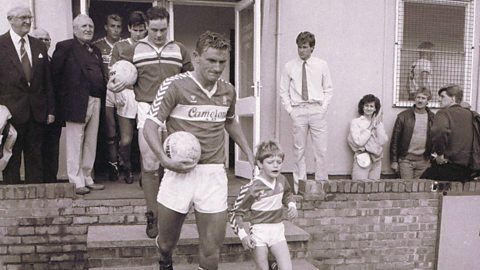
Middlesbrough FC wearing shirts sponsored by Camerons

The York Brewery produces a fantastic array of cask and bottled beers, including the ever-popular 'Guzzler' (a refreshing session beer, 3.6%).  They also offer a range of keg beers (although the kegging takes place  at Camerons 'Lion Brewery' in Hartlepool, which coincidently features prominently in our chapter.)  


Friday, 20 May 2016

Beer and the Boro - A Perfect Match!

 middlesbrough 1985-86

If your university of library has access to Springerlink, you can easily download the digital edition of our new book chapter 'Beer and the Boro - A Perfect Match!'


"Although football clubs (FCs) as firms are relatively unsustainable from a purely financial perspective, the club brands appear highly sustainable in comparison with many other industries (Kuper and Szymanski, 2012). While the ownership and the companies running the clubs may change, the club brands themselves appear to be more stable than in other industries where firms and brands go out of business, relocate or diversify to a far greater extent (e.g. Hannah, 1997). This may be because they are less vulnerable to competition — FCs have historically been geographic, and while their catchment area may shrink during less successful periods, it will not disappear entirely. Furthermore, rival foreign clubs do not enter and supply soccer at lower prices (although foreign investors may bid to take over the ownership) and although English clubs as a whole could fall behind foreign competitors and lose their best players, foreign clubs have their own problems of finance and management (Kuper and Szymanski, 2012). Put succinctly, society can keep unprofitable clubs going cheaply: bank managers and tax collectors have historically appeared reluctant to close century-old clubs -and so society swallowed the losses. Perhaps clubs were and still are too small to fail. At the same time, the brand loyalty of supporters means that no matter how lousy the product, a hard core of customers will continue to purchase: “Soccer is more than just a business. No one has their ashes scattered down the aisle at Tesco” (Taylor, 1998, cited by Kuper and Szymanski, 2012, p.82)."


In the chapter, we discuss the relationship between the beer and brewing industry and football in the 1980s, through the case of Middlesbrough FC, a club which experienced severe financial challenges during the 1980s.

So what are you waiting for - have a read, put it on your reading lists, cite it in your research. You know what to do!


http://link.springer.com/chapter/10.1057%2F9781137466181_16

Thursday, 12 November 2015

Come and see the Soccer Mad Boffins in Middlesbrough


We are pleased to announce that we will be presenting our research on Middlesbrough Football Club at the Urban Leisure Conference organized by the British Society of Sports History's North East and Yorkshire Network on Saturday November 14th, at Teesside University.  Our paper reports on the relationship between Middlesbrough FC and its local authorities in the 1980s and draws on previously unpublished archival sources as well as our forthcoming book chapter and world cup book. Registration will be at 10am and at 10.30am there will be a keynote by the esteemed football writer Harry Pearson.  Our presentation will be at 11.45am. The event is free to attend and you can book here - http://www.tees.ac.uk/sections/whats_on/events_details.cfm?event_id=7824 - We look forward to seeing you there!

Monday, 19 October 2015

Contribution to the website of Montrose FC


Soccer Mad Boffin Dr Alex Gillett has contributed an article about his Grandfather, footballer Giles 'Gil' Gillett, to the website of Scottish club Montrose FC.

After national service with the BAOR (British Army of the Rhine) Giles played professionally in the late 1940s/early 1950s, initially with English team Middlesbrough before transferring back to his native Scotland where he spent two seasons with Leith Athletic before signing for Montrose.

Included on the website are digitized archival documents including a copy of Giles' Montrose contract and player registration, as well as a match programme (Montrose vs Heart of Midlothian FC) and photographs, all of which may be of interest to people researching Scottish or post- WW2 football

The article can be found by clicking here.