Friday, 15 May 2020

World Cup Animation Featuring Our Book

Our book "Foundations of Managing Sporting Events: Organising the 1966 FIFA World Cup" is featured in a new animation available on Youtube entitled "How North Korea and Middlesbrough Became Unlikely Football Friends".

The animation, which lasts around 8 minutes long, tells the story of Middlesbrough and North Korea's unlikely friendship, which begins at Ayresome Park in 1966.


The video was produced by Tifo football, and the script was written by Dr Tosh Warwick of Manchester Metropolitan University. It draws from Dr Warwick's own excellent research on the 1966 World Cup, and a comprehensive review of literature relating to the tournament, including our book, which the film describes as "groundbreaking".

Pak Doo Ik's winning goal secured the Asian minnows a place in the quarter-finals of the FIFA World Cup. There, a curiosity developed in the Middlesbrough locals, after initial disinterest in the team, and the lowest recorded match attendance in the tournament. What evolved over the games, however, was a connection that warmed the hearts of many and one that has continued into the 21st Century.


Check it out by following this link: https://www.youtube.com/watch?v=h5M7Xf3HwAs

Thursday, 7 May 2020

New Article Alert: The Rise of Marketing

A quick newsflash to announce a new text, 'The Palgrave Handbook of Management History' (Palgrave, due August 2020) print edition is available now to pre-order.  The electronic version is available now, and will be made available to anyone that pre-orders the print edition.  The book is edited by a team of top management history experts led by the editor of the Journal of Management History Bradley Bowden, as well as Jeffrey Muldoon, Anthony M. Gould and Adela J. McMurray.

Although we have not written any sport or soccer-specific content for this book, we have co-authored a chapter entitled 'The Rise of Marketing' which focuses on the era from the early 20th century until the 1980s.  This is an area of management and theory we have of course written about in papers published elsewhere, about marketing and soccer clubs and the world cup.  

Kevin has provided another couple of chapters on 20th-century management, focusing on the work and impact of the paradigm creating business historian Alfred D. Chandler, as well as a chapter about the history of strategic management writing, and edits a section of the book focusing on the history of management between 1940 and the 1980s, a period considered the height of modernity.  Other authors who appear in the section include Jim Philips writing about Industrial Relations, Alice White discussing the rise of Organizational Psychology, Kaylee Boccalatte and Bradley Bowden on Keynes' rivalry with Hayek, and John Quail, focusing on the struggles of British management after World War Two.  This will be a useful contextual section for sports historians to draw on.

The book more broadly contains chapters by the editors and other scholars on both classical topics for management historians including (but not limited to) the industrial revolution, the impact of Ford and Taylor, and the Tavistock Institute. It looks at a broad selection of less well-trodden periods and geographical contexts too, from antiquity to the medieval, and early modern, from China and Russia to Africa.  There is likely to be something of interest to everyone in the book!  Click here to see a list of chapters already finalized.


  •  “The most comprehensive and in-depth examination of its subject matter in the market place.
  • - Spans management history thought and traditions
  • - Maps the discipline both temporally and geographically
  • - Engages with pre-modern ideas and post-industrial concepts


Overall, it is an extensive reference book of around 1200 pages, and is priced to appeal to libraries rather than individuals.  The chapters are useful summaries which can get students up to speed on a variety of topics.  So if this looks interesting to you please request to your university librarian that they purchase for their collection:

Click here to find out more (and please share this link with your friendly librarian/library purchasing officer): 9783319621135

Tuesday, 28 April 2020

New Article Alert: Sport and Project Management

Greetings!

We are pleased to announce a new book chapter that we have authored has been published.

The paper entitled "Sport and project management: a window into the development of temporary organizations" is included as a chapter within the Handbook of Research on Management and Organizational History, published by Edward Elgar Publications as part of their 'Research Handbooks on Business & Management' Series. 

Abstract:

The historical study of project-based industries allows largely unexploited opportunities for empirical, methodological and theoretical contributions to the field of management history. McDowell (2015) and Scranton (2014) demonstrate that the study of projects can enable an understanding of temporary and virtual organizations that link together multiple agencies each contributing to an overall value or ‘legacy’ comprising outputs and outcomes. This chapter proposes that researching global or continental scale sport mega-event projects can capture these attributes, for example the delivery and associated long-term legacy of the Olympic Games or FIFA World Cup. Project management history therefore offers a window into the delivery of a project as well as a broader opportunity to study the ways that organizations and individuals within them cooperate to deliver outcomes allowing management historians to contribute to debates around the usefulness of such events to society, as well as the institutional context within which they are nested.


The reference details are as follows:

The Chapter:

Gillett, A.G. and Tennent, K.D., 2020. Sport and project management: a window into the development of temporary organizations. In Handbook of Research on Management and Organizational History. Edward Elgar Publishing. 
DOI:
https://doi.org/10.4337/9781788118491.00016


About the book:

Emerging from what was a somewhat staid sub-discipline, there is currently a battle for the soul of Management and Organizational History (MOH), at the centre of which is a widespread concern that much recent work has been more about how one should or might do history rather than actually doing historical work. If ever there was a time for a new volume on MOH, this is certainly it.

The Handbook, which is edited by Kyle Bruce, comprises many interesting and useful chapter clustered into three sections. Part 1 is concerned with 'Classic Foundations', Part 2 gives a platform to 'Alternative Voices' and Part 3 is 'About History'.

Our Chapter is located within Part 2.


Cover Handbook of Research on Management and Organizational History


Published:
1 April 2020
ISBN:
9781788118484
eISBN:
9781788118491
DOI:
https://doi.org/10.4337/9781788118491
Pages:
 320


Wednesday, 23 October 2019

New Article Published by 'Soccer & Society'

We are pleased to announce that our latest paper '‘Filip’ or flop? Managing public relations and the Latin American reaction to the 1966 FIFA World Cup' is now available online.

It is published by the journal 'Soccer & Society' and will when available in print it will be included in a Special Issue on the topic of 'Moments, Metaphors, Memories: Defining Events in the History of Soccer'.

First 50 readers using this weblink get FREE access to our article by clicking HERE

Thereafter you can find it by clicking HERE


The 1966 FIFA World Cup has become part of the iconography of its hosts and champions, England. Extant literature has tended to focus on the cultural and symbolic legacy of the tournament, or engaged with diplomatic relations between Britain and North Korea. Contrastingly, we use archival sources from footballing and government institutions to explore the less studied topic of how the tournament was reported and perceived in Latin America, where England had commercial interests and influence, but where there were allegations that FIFA, the FA and even the UK government manipulated the tournament to the advantage of England and other European teams. We provide fresh perspectives on the social and cultural significance of the 1966 FIFA World Cup by analysing how the tournament’s organizers attempted to manage the situation and resulting negative public relations, and how 1966 fits within longer-term footballing and diplomatic relations between England and Latin America.


Thursday, 10 October 2019

Football Fundraisers

The last few weeks have seen a couple of events that coincidently had two things in common: Firstly, they were both fundraisers for causes in some way related to neurological conditions, and secondly; Alex attended both of them. 


Event One: Middlesborough FC 1986 Reunion

The first was an event up in Middlesbrough, at the Beechwood, Easterside & District Social (BEADS) Club - billed as a reunion of the Middlesbrough FC squad of 1986 which took the team from financial liquidation to promotion out of the old Third Division in just a few months. 

(We have previously published two papers about that mid/late 1980s Middlesbrough team - see here and here  - but articles may be behind a pay wall if you are not in a university library). 

Bernie Slaven and team-mates from 1986 talk about the glory days

The night was in aid of that squad's former young star Gary Parkinson, who now has 'locked in syndrome', a rare neurological disorder in which there is complete paralysis of all voluntary muscles except for the ones that control the movements of the eyes.

Alex meets Bruce Rioch
Gary Parkinson and family were in attendance, together with the vast majority of the 1986 squad and its manager, Bruce Rioch, or 'Sir' Bruce as he is known in that part of the world.

As well as most of the stars of 1986 (Pears, Parkinson,  Cooper, Mowbray, Pallister, Hamilton, Laws, Ripley, Kerr, Slaven, Stephens, Turnbull, Proudlock, Rioch) another famous face was Mark Proctor, who featured in early and late 1980s Boro teams (with a few years at Sheffield Wednesday in between), as well as darts player Glen 'Duzza' Durrant, and Middlesbrough's current manager (and former 'Boro and England star player) Jonathan Woodgate.

The event was packed out and all tickets were sold.  the lucky fans in attendance were able to ask questions and have photos taken with all of the players and Bruce, as well as collect autographs. There was also an auction and autographed photos for sale.  

This event was in aid of the Gary Parkinson Trust- for more information please visit https://www.garyparky.co.uk


Event Two: Daniel Parslow Benefit Match (York 2012 v All Stars)


The second event was a testimonial match for York City player Daniel Parslow, whose playing career ended abruptly earlier this year, when he was concussed during a game.  Head injury is a serious risk in sports such as football, and Daniel is now championing the use of concussion protocols into the game.

Programme and badge available to buy outside of the ground

The two teams involved were a 'Wembley Twice 2012' side, versus an 'All Stars' team of other invited players: 


Over a thousand fans attended the game York's Bootham Crescent ground on a cold October Wednesday night, to demonstrate their respect for the player.  

The York 'Wembley Twice 2012' team warm up on a cold autumnal evening

Bootham is an old fashioned soccer stadium from the days of wooden seats and cups of Bovril - a throwback to the days before plastic seats and prawn sandwiches. It will be a shame to lose that historic atmosphere when the club eventually relocate to its new-build community stadium.


At half time, a presentation was made between Daniel Parslow and the charity Headway which specializes in 'improving life after brain injury' and has assisted Daniel Parslow since his concussion.   To find out more about brain injury or to find your local Headway, visit headway.org.uk or call its nurse-led freephone helpline on 0808 8002244.


Photographers capture the half-time presentation between Daniel and Headway

The game was equally competitive and fun - at one point in the first half former York star striker Jon Parkin, playing for the All Stars, had the ball taken from his feet by one of his own players, which received laughter and cheers from the crowd and players.  Then Parkin put on the goalie's jersey for the second half, making some great saves, but also being beaten on a few occasions. 

A rare photo of Jon Parkin keeping goal, instead of scoring goals. 

Goals came thick and fast, so much so that even Soccer Mad Boffins lost count and it may have ended 7-5 to the 'Wembley Twice 2012' team, or was it the other way round? Or were there even more goals? Answers on a postcard please, if you were there! (update: According to newspaper The York Press, the All-Stars won 7-4! news report all about the game can be found here)


Action at one end of the field....

...and then at the other
Goooaaalllll! Pick that one out of the net, etc. Just one of many goals that were scored!
At the end of the game all of the players lined up for commemorative photographs, and received a round of applause from the crowd, who clapped in unison as the tannoy announcement urged us to 'keep the faith' to a soundtrack of Status Quo's hit 'Rockin' All Over the World'.

legends re-united: a group photo opportunity after 90 minutes

The crowd dispersed into the night, over a thousand of us on a chilly Wednesday night in October, shows how much the fans wanted to show their appreciation and support the great players and this great cause.

Over 1000 fans attended to support a great cause


(For a research paper about fans in lower league and non-league soccer, visit here - if you can't access the published paper you can access a pre-print draft version here)


Wednesday, 28 August 2019

Financial Troubles at Football Clubs: York Festival of Ideas, and the cases of Middlesbrough, Bury and Bolton


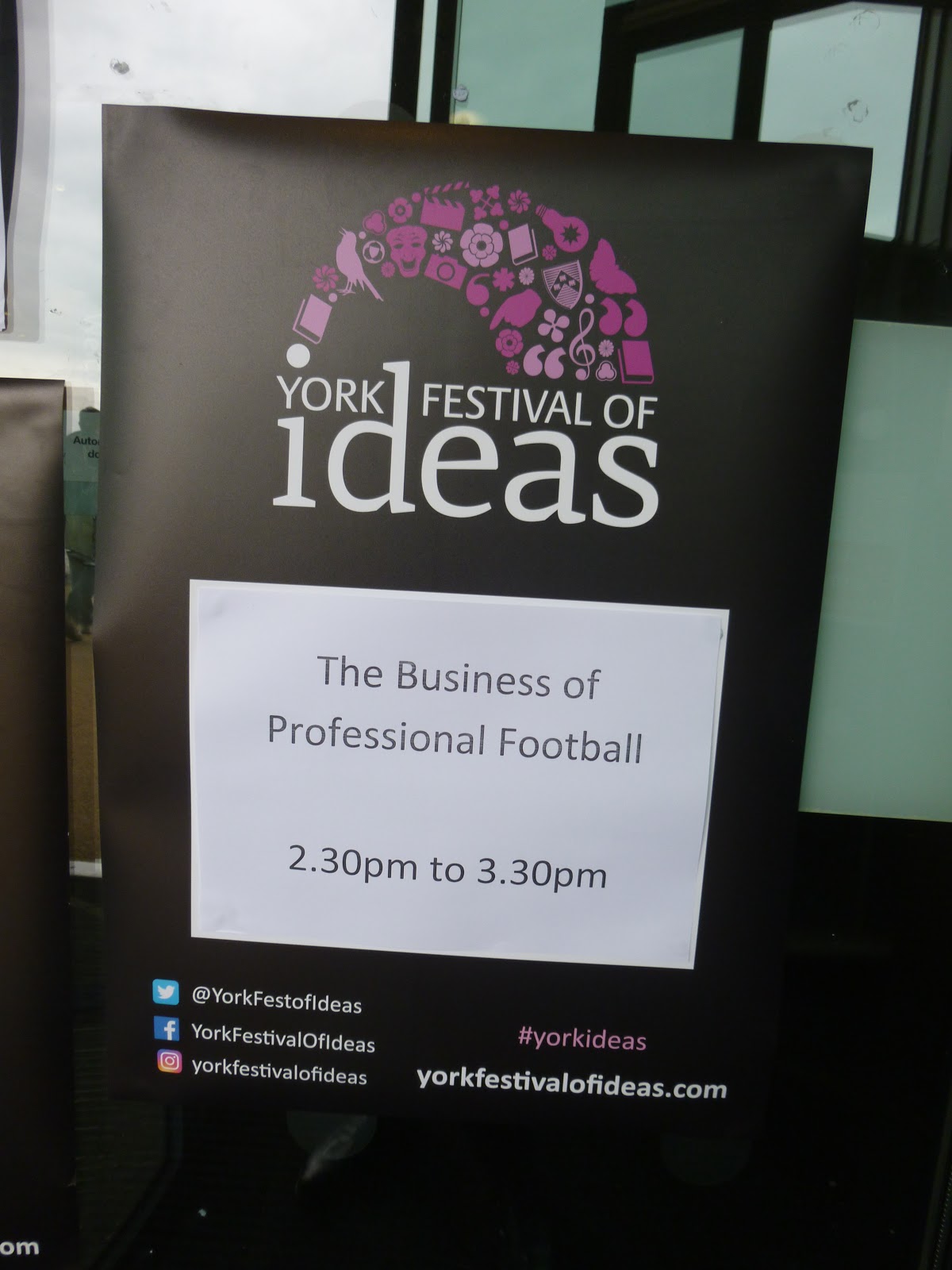
Back in June it was our great privilege to present our research at York festival of Ideas.

We were involved with two sessions - the first, Chaired by Kevin, was a highly insightful presentation by Daniel Geey - a legal/business expert with significant experience in the football industry and has worked on a variety of club takeovers, high profile transfers, commercial endorsement deals and disputes. His talk centered around his book and was entitled 'Done Deal: Premier League Big Business' and generated much discussion from the audience about players, their agents, and tax issues - and some were also interested by the ethical implications that can arise. Thanks Daniel for a truly insightful presentation.


Next, we were both in conversation with best-selling investigative journalist and author, David Conn.


The event was notable for several reasons.

Firstly it was a first public appearence by Alex after experiencing serious illness earlier this year. Although he sat down for most of the event, getting out and in front of an audience was a big step forward in his recovery.

Secondly, sharing the 'stage' with David Conn was a real accomplishment.  On a personal level it was great to talk to him about our research, which has drawn on some of the facts an  ideas outlined in his books, particularly 'The Beautiful Game: Searching for the Soul of Football'.  Coincidently we were also undertaking our own research of the World Cup (and related to that, the history of FIFA) at around the same time as David was doing his own research, albeit more concerned with criticisms of the organization in its more recent form, and ultimately published in his 2017 book ''The Fall of the House of FIFA'.  


The talk began by Kevin outlining the work we have published, particularly the ideas of Shadow Hybridity and the Institutional Logic of Professional Sport, as outlined in our recent paper featured in Journal of Management History: 

Final published version (look it up via your university library): click here 

Accepted penultimate draft (unformatted document, freely available with no paywall): click here

Alex and Kevin then made links between our theories and the ideas presented in David's books about finance in football, and contrasting cash-strapped lower league teams, such as Middlesbrough in the mid-1980s with, premiership today's giants such as Manchester City and the concentration of wealth resulting in ever widening gaps between them and many teams of the lower leagues.

David responded passionately with detailed answers - he really cares about the subject matter - and has researched it thoroughly.

The things that we talked about that day struck a chord with the audience, many of whom had question and insightful comments to make about their own perceptions and experiences as fans.  

As some of you reading the will know, David Conn is a former student of University of York, the venue and a main organizer for the festival of Ideas.  After the event we took David for a walk around his old campus and enjoyed talking about the place.  Thanks David and also thanks to everyone at the Festival of Ideas team and the University of York for hosting our event, and to everyone who attended on the day for being a brilliant audience. Both of the football talks were free to attend but fully booked, so see you again next year, we hope, but book early!


David Conn revisits University of York (photo credit: Alex Gillett)


                                                                           ******


Reflections on Today's News

The last couple of days have brought these issues back into focus and our ideas about the institutional logic of professional sport have never seemed more pertinent, with Bury today being expelled from the league and Bolton Wanderers hanging on by a thread.  Two clubs with much history, including famous FA Cup wins.  

As Bury and Bolton, once proud Lancashire towns, have been consumed Pac-Man like by the 'Greater Manchester' metropolitan area, their economies as well as their football clubs appear to have declined financially, if not always so on the pitch (Bury were only just promoted this summer and Bolton have for many years been a bit of a 'yo yo' team but tend to pivot around the second tier)- whilst those of the dominant geography (ie the city of Manchester) have experienced what seems to the outsider to be a concentration of inward investment, and glory (United and City are both now globally recognized brands- and City won a clean sweep of domestic honors last year). 

Even Salford, a former dockland area (in the shadow of Old Trafford in one direction and the National football Museum in another) but newly revived by the arrival of the BBC at 'Media City' in 2011, now have a team competing professionally in the English Football League.  

Salford City FC is  buoyed financially by a consortium ex-Manchester United players' who seemingly preferred to 'start from scratch' and begin a new generation by taking a non-league club (as it was when they invested) into the league (where it is now), rather than take on the baggage of an established local league club with an existing fan base, but also the weight of history and the albatross of debt.  

For example the Neville brothers (Phil and Gary) have a combined ownership stake in the Salford Club of 20% according to Wikipedia - whilst by way of contrast their mother Judy worked as Bury FCs club secretary until recently, and their late father was at one time on the Bury FC Board of Directors (according to the BBC).  

As we outline in our paper, fans want to win and professional football clubs demand more and more money in order to retain their professional status.  Without constant investment and the promise of 'being in with a chance of promotion/winning the cup' will eventually lead to many paying fans deserting in their droves, and also lead to extra expense from 'sacking' managers, player wages and fees etc, to attract talent in the hope of turning things around. Maintaining professional status in order to be narrow the odds of achieving glory, creating a 'buzz' and attracting sponsors and television money, to re-invest in more players and stadiums seems to be the cycle of events time and again - only for some clubs that cycle becomes a death spiral, particularly if owners' laden more debts onto the club, for example by diversifying into sports halls/public gyms, hotels, or to subsidize some of their other business interests. 

We wish Bury and Bolton the very best of luck for the future, and hope that the precedents set by others such as Middlesbrough (which escaped by the skin of their teeth in 1986), and Accrington Stanley (which reformed after leaving the league in the 1960s - eventually returning in 2006 and now comfortably placed in League 1.)  

More closely to home we also hope that York City can capitalize on their strong start to the season and climb back up the pyramid soon.  It has been a turbulent few years for York and it would be great to eventually have League football at the new stadium when it is eventually opened.


Tuesday, 13 August 2019

An Evening at...Pickering, Yorkshire

A warm, rainless evening at the end of July presented a golden opportunity for a Soccer Mad Boffins field trip.

The occasion was a pre-season 'friendly' fixture between Pickering Town FC, and York City FC. So close to the start of the 2019/20 campaign, the game provided an opportunity for both teams to field some trialists and give youth and squad players opportunity to showcase their abilities and jostle for a place amongst the first-team.

Prior to the game, neither of us (Alex and Kevin) knew much about Pickering Town FC.  What calibre of team, or what sort of ground they had was a mystery. In years of visiting the quiet Yorkshire market town with our families for its heritage railway, World War 2 theme weekend, its castle, country fair/traction engine rally, trout farm, and medieval church, it is fair to say that 'football ground' had never really been on anyone's radar.

Pickering Castle (image: Historic England)
Pickering has several family-friendly events throughout the year

Alex was surprised to discover that despite the town having a renowned trout farm (and the club being situated from it by about 5 minutes by car) the fish on Pickering's club crest were in fact Pike.  Thus, Pickering Town FC are known not as the 'trout-men' as we had guessed, but 'the pikes'.  Closer inspection of the club crest revealed that it said 'Pikes' in large letters, and also that the club was formed in 1888, and so has a bit of history behind it.


The club now plays in the Northern Premier League and has in recent years enjoyed good runs in the FA Vase and also the North Riding Senior Cup.  Of relevance to Soccer Mad Boffins publications is the fact that Pickering's list if ex-managers includes Mitch Cook, who was part of the mid-80s Middlesbrough squad that we wrote about in our chapter 'Beer and the Boro' and recent paper in the Journal of Management History (Cook was even listed in some copies of the match day program in the team for 'the Boro's come-back game at the start of the 86-87 season in the old Division 3, but had left for non-league Scarborough just days before the fixture took place).

We were pleasantly surprised to find the sports ground so easily (just off the way in to Pickering if traveling from York) and that parking was conveniently right next to the ground - which is a bit of an all-round sports and rec facility incorporating a cricket green as well as the soccer ground.    Entering through the sole turnstile, we made pilgrimige to the programme seller and also each bought a strip of raffle tickets - top prize was a meat pack from a local butchers - although neither of us won, its the taking part that counts!

The 'Pikes' crowd management system: Green turnstile


Souvenirs from a great day out: Match program, ticket, and losing raffle tickets


Even more remarkable was the picturesque setting, and the facilities with covered stands, a good clubhouse selling beer and pies, and a well maintained pitch - although it does have an eccentric slightly raised edge where the width of the field overlaps with the raise towards the adjacent cricket pitch!


Picturesque view at Pickering's ground: Perfect backdrop for a game of footy
An impressive stand

Notice on side of the clubhouse


Prior to the game starting, in the team warm-ups the York City players looked a tad sharper with more precise ball-juggling skills and better 'first touch'.  However, such impressive skills do not always translate into the 11-a-side game, even in a 'friendly' game when so many players are trying to prove themselves in order to win a contract or a call-up to the main squad or first team.


Pickering's squad warm up before the game


Kick-off was at 7.30pm sharp, by which time the ground was quite full, a good local turnout as well as a dedicated trailing contingent from the 'big smoke' (York!) down the A64.


Teams prepare for kick-off: York in red, Pickering in blue


"And they're off! The Charge of the York brigade!"


The game began at a fast pace.  York's team containing full-time professionals used to playing higher-tier non-league soccer (or even league soccer in some cases) really 'went for it' from the first whistle, opting for a direct or even long-ball style, to capitalize on their pace against the part-time Pikes.  Passing the ball up field with power, or diagonal crosses from the left-back up-field to the right-wing, was a default setting.  To be fair York's right-sided players never seemed to run out of energy, but neither could this approach create many chances against a cool, calm and collected Pickering side that kept their line across defense and passed it out accurately through the centre into midfield.

Indeed, Pickering's more aesthetically pleasing passing game took hold and turned the pace of the game (a style they've cultivated for some years, apparently, introduced by Mitch Cook a few years ago to instill a style or brand of football to the club).  York then tried to fight fire with fire, settling into a better passing game themselves, but in all honesty it was a fairly even match, and difficult to tell apart the part-timers from the full-time professionals.  If anything, York looked less organized and more clumsy than Pickering across their defense. These players were perhaps not used to playing alongside one another, and despite their impressive skills during the warm-up, the passing out of defense was not very accurate compared to Pickering's, even if the first-touch and ball control was slightly better.


Fast paced, end-to-end action: York look for options in the top right corner as Pickering close the angles

Surprisingly, by half-time, Pickering had netted twice to lead 2-0!  Both goals were well deserved although one had resulted from a calamitous mix-up between York defender and goalie, who both shouted to collect a loose forward-ball from Pickering, but ended up with the defender lobbing his own 'keeper who had rushed out for it, leaving a Pickering trial list free to chose it towards the goal line and poke it into the back of the net.

Nobody knows for sure what was said to the York players at the half-time interval in response to all of this mediocrity against part-time opposition, but we can only imagine that the slightly re-shaped team (a couple of substitutions, most obviously in defense) which emerged for the second half were playing to ensure the future of full-time professional football in the City of York.

And play they did, it was a more focussed and positive side from the very beginning - which resulted in a quick blizzard of goals. York were level to 2-2 after about ten minutes of play and the cracks began to show in Pickering's armor, particularly across the back line - one or two players' heads noticeably dropped and a couple of the team started to bicker and swear at one another.

In contrast, York, which had seemed the less professional of the two sides in the first half, had responded with resilience best summed up as more speed, enduring stamina, and a 'can-do' attitude with more accurate passing and finding space. Maybe it was the player changes, maybe it was a matter of pride, but against a couple of the Pickering players' chins dropping at conceding a couple of goals, York now looked by far the more professional outfit.

A bit of rough play ensued, and the yellow card was brandished on at least a couple of occasions, as well as a few more substitutions to rest players that were picking up knocks and to give some very young looking players a bit of experience. One joker in the crowd quipped that 'those numbers on the subs backs are their ages' (the numbers were 14, 15, 16!)

In the end, two more goals were scored by York, meaning a final score of Pickering Town 2 - 4 York City.

A thrillingly entertaining match for the neutral supporter with plenty of goals and a determined spirit that encapsulated the rivalry between two geographically close teams packed with players out to make a point and stake a claim to a squad number for the 19/20 season. Great stuff.  Good luck to both York and Pickering for the new season.