Showing posts with label university of york. Show all posts

Thursday, 11 June 2026

United 2026 FIFA World Cup is Here! Tournament Predictions are Here!


The 2026 FIFA World Cupo kicks-off TODAY, co-hosted by Canada, USA and Mexico.

In this blog post we look back at our existing published research on USA world Cups, before statibg our predictions as to who will win it and what fate has in store for the British teams and also for the co-hosting nations.

We then compare with the predictions of colleagues from some of our mathematical colleagues.


Reflections

Way back in 2018 we were asked to share our thoughts on the then newly announced 2026 FIFA World Cup for Canada-Mexico-USA, a tournament to be co-hosted across North America.

Our piece, linked here, shared our projections about organising the tournament and likely scenarios, such as for urban transport, boosterism and so on. We also reflected on the making use of existing stadiums rather than building many new stadiums from scratch for the tournament.

Relatedly, those of you who follow our academic publications may also be aware of our articles on the USA 94 edition of the FIFA World Cup:

Gillett, A.G. and Tennent, K.D., 2022. Hybrid goals: Institutional complexity and ‘legacy’in a global sporting mega-event. Public Management Review, 24(3), pp.372-397.

Tennent, K.D. and Gillett, A.G., 2020. Opportunities for all the Team: Entrepreneurship and the 1966 and 1994 Soccer World Cups. In Sport and Entrepreneurship (pp. 145-166). Routledge.


We have also very recently revised and updated our chapter 'a brief history of the world cup as a business' in the book 'The Business of the World Cup'. The first edition, which appeared in 2022 in time for the Qatar tournament, was very popular. So, were delighted to be asked to participate in a new edition to coincide with the 2026 World Cup:

Gillett, A.G. and Tennent, K.D., 2027. A Brief History of the FIFA World Cup as a Business. In The Business of the FIFA World Cup (pp. 4-24). Routledge.


Predictions

But what of the on-pitch activities? Well, as our readers know, we like to do tournament predictions and wherever possible compare to other 'expert' academics and pundits. As usual, both of us predicted results for the entire tournament and also rolled dice for a bit of fun to see if we are more accurate than random chance!  Results are:


Name

Winners

Runner-up

Third Place

Fourth Place

Kevin

Brazil

Croatia

Netherlands

Argentina

Alex

Brazil

Spain

Argentina

France

Dice

Egypt

Mexico

South Africa

France


Alex predicts that Brazil will beat current Holders Spain by 2-1 to lift the Cup for the sixth time, but the first time since 2002.  This would fit a pattern; Brazil have never waited longer than five tournaments to win it, so they are due that victory!  

He predicts that England will reach the Round of 16 where they will be beaten 0-2 by Spain on their way to the Final. Meanwhile, of the British Home Nations, Scotland will progress out of the Group Stage for the first time in history, but face 2-3 defeat to Netherlands in the Round of 32.

Of the three host nations; Canada and Mexico will both finish second in their respective groups before Mexico knock-out Canada 2-0 in the Round of 32, then Mexico lose 2-3 to Netherlands in the Round o f 16. USA will win Group D before losing 1-2 to Ecuador in the Round of 32. 


Kevin also sees Scotland's bravehearts losing to Netherlands in the Round of 32, but predicts a penalty shoot-out will decide that after a 1-1 draw is not settled by extra-time.  England, he predicts, will lose 2-3 to Brazil in the Quarter Finals.  Brazil will ultimately win the Cup, he proclaims, suggesting a 1-1 draw followed by a Brazil winning goal in extra-time.

His outlook for the co-hosts sees Canada falling at the Round of 32, losing 1-2 to Czech Republic after finshing second place in the Group. USA will win its Group , beat Iraq and Korea Republic in the knockout stages, before crashing out 0-3 to Croatia in the Quarter-Final.  Mexico will win every Group stage game but exit in the Round of 16 at the hands of England.


The dice, as wild as ever, predict Egypt to play co-hosts Mexico in the Final, 3-3 after 90 minutes followed by a further 1 goal for Mexico and 5 for Egypt in the most exciting period of extra-time in the entire history of World Cups.  Scotland will win Group C before losing to Netherlands in the Round of 32, whilst England will go out in the Round of 16 courtesy of a 4-5 defeat at the hands of South Africa. Other than Mexico, of the co-hosts, both Canada and USA will falter at the Group Stage.


Compare to Colleagues

The Corridor of Uncertainty is a podcast at the intersection of maths & sport, hosted by Dr Jess Hargreaves & Dr Rich Bingham, two mathematicians at the University of York. In their episode dated 9th June 2026 they calculate, using their own mathematical formula, the liklihood of each participating team winning the competition. According to their number crunching, Spain are most likely to lift the Cup, followed by Argentina, France and then England.

They also invited a special guest, Prof James Reade (Uni of Reading), who introduced his own set of figures to offer an alternative prediction: Favouring Argentina, then Spain, France and Portugal as most likely to take top honours. His prediction for England/ Fifth most likely to win.


The outcomes then are very much open to debate. What is certain is that the next few weeks will provide good opportunity for more blog posts and podcasts!

As usual we will try to update our predictions at each stage when it is know who has qualified.


Please note that the above predictions are for fun only and are not advice for betting on the outcomes of these or any football games. The authors cannot  accept any liability for the performance or outcomes.


Monday, 8 June 2026

Report: York Festival of Ideas 2026


On Saturday 6th June we had the great pleasure to host North East subculture hero Robert Nicholls (lead singer of Shrug, editor of England's longest-running football club fanzine 'Fly Me to The Moon' and internet message board, and sport heritage/history/archaeology practitioner to name just a few things from his varied career).

The audience was treated to Rob's knowlegeable (and at times amusing) take on football stadiums, heritage projects, and the real and virtual spaces and places that help to define football.

The 30 minute presentation was followed by a further 30 minutes of audience questions, which led to some finer details and humorous anecdotes, and afterwards attendees had the opportunity to take home samples of Rob's football zine.

This event was back-to-back with another presentation by our Uni of York colleague Jess Hargreaves, all about the use of statistics in modern football. Two very different angles on 'the people's game' but together made for a highly interesting couple of hours.

Thank you to Rob and to the Festival Team for excellent organisation and hospitality. See you again!


Wednesday, 9 July 2025

Report: York Festival of Ideas with author Daniel Gray 'The Delights of Football'

On Saturday 7th June 2025 we had the honour of hosting author Daniel Gray at the University of York's Festival of Ideas.

Daniel has been on our radar since 2018, when his book Saturday, 3pm, was recommended. It was therefore a treat to finally meet the author and to share with our audience the opportunity to hear him read.

Daniel read selected passages from three of his books, including several from his more recent 'Delights of Football' series.

Daniel's writing has drawn comparison to the artwork of Lowry, for his ability to find delight in every day life in a way that resonates with his audience.

There was something for everyone in his observations on receiving the fixture list, watching referees fall over, the smell of pies and fried onions in and around the stadium.  He paints pictures with words and even the few people in the audience who weren't fans of football enjoyed the poetic prose.

Sighted in the audience was our guest speaker from last year, Dr Tosh Warwick, who kindly photographed the event.


Photo with thank to Dr Tosh Warwick


The Soccer Mad Boffins series within the York Festival of Ideas continues to draw and sizable, enthusiastic and diverse audience. We thank everyone who attends and to the university and especially the festival organisers, in particular Joan, Naomi and Caren, who have believed in us since we began and without whom these events would not be possible.

A complete list of our Festival of Ideas appearances is included below, with links to Youtube for those which were recorded and still available to watch online. Note that this does not include appearances at other events such as York Researchers Night, at which you may also have met us:


2025 with Daniel Gray 'The Delights of Football' click here to watch


2024 with Dr Tosh Warwick 'Lost Football Grounds' click here to watch


2023 with  Dr Alexander Jackson 'Curating the World's Game: An Audience with the National Football Museum'  click here to watch


2023 with Dr Duncan Stone 'Different Class: The Untold Story of English Cricket' click here to watch


2021 with football Referee Keith Hackett 'Rules of the Game: On and Off the Pitch'


2019 with investigate journalist David Conn 'The Business of Professional Football'


2019 with football agent Daniel Geey 'Done Deal: Premier League Big Business'


2018 with former FA Chairman and Director-General of the BBC Greg Dyke on 'The Business of World Cup Football'


Tuesday, 9 January 2024

Study the business history of the FIFA World Cup.....for FREE


Soccermadboffins with University of York proudly present a new three-week duration online course all about the business history of the FIFA World Cup.

The course is available to enroll on free of charge (or for a modest fee for extra perks and opportunity to earn a certificate).

The course begins on 29th January 2024 and requires no prior university education.

For more information watch the above video and visit this link.


Friday, 16 June 2023

York Festival of Ideas 2023

On Saturday 10th June 2023, The Soccer Mad Boffins chaired two author discussions at the University of York Festival of Ideas. Or at least we were supposed to, but due to ill health Kevin had to withdraw his involvement at the last minute. So, Alex stepped up to chair both talks on his own, although Kevin had contributed equally to the proposals, planning, and preparing lists of questions.

The first talk extended the Soccer Mad Boffins into cricket. Dr Duncan Stone discussed his recent book 'Different Class: The Untold Story of English Cricket' (Repeater Books, paperback ISBN: 9781913462802) which explores the governance of cricket and impact of social class rigidity.  It also raises questions about outreach, public relations, and 'marketing' of the game to participants and to fans, and Duncan suggested ways to re-imagine the cricket sport 'product' that he believes would help it to become a 'people's game'.

The second talk was with Dr Alexander Jackson of the National Football Museum. He discussed his latest book 'Football's Great War: Association Football on the English Home Front, 1914 1918' (Pen and Sword, Hardback, ISBN 1399002201). Discussion then turned to the National Football museum, and curating sensitive content such as war, as well as the less sensitive topic of current and upcoming exhibitions at the museum, which is definitely worth visiting. An interesting point was how football was used to recruit players and fans to the war effort, how finances were managed to keep clubs in business, the ethics of sustaining sport during war, and how football managed its public relations and its communications/messaging during this difficult time, to it supporters, with examples of advertising from the museum's collection.

Both talks were well attended with lots of great questions from the audience in addition to those asked by Alex.

Afterwards both authors signed many copies of their books for eager attendees.

Thank you to all involved with organising and operating the Festival and for making it the amazing annual fixture that it is.

You can watch the videos of both talks free of charge using the below links;

Duncan Stone - 'different class'

Alex Jackson of National Football Museum - 'Curating the world's game - football's Great War'


Sunday, 13 November 2022

Guest Lecture by David Smith


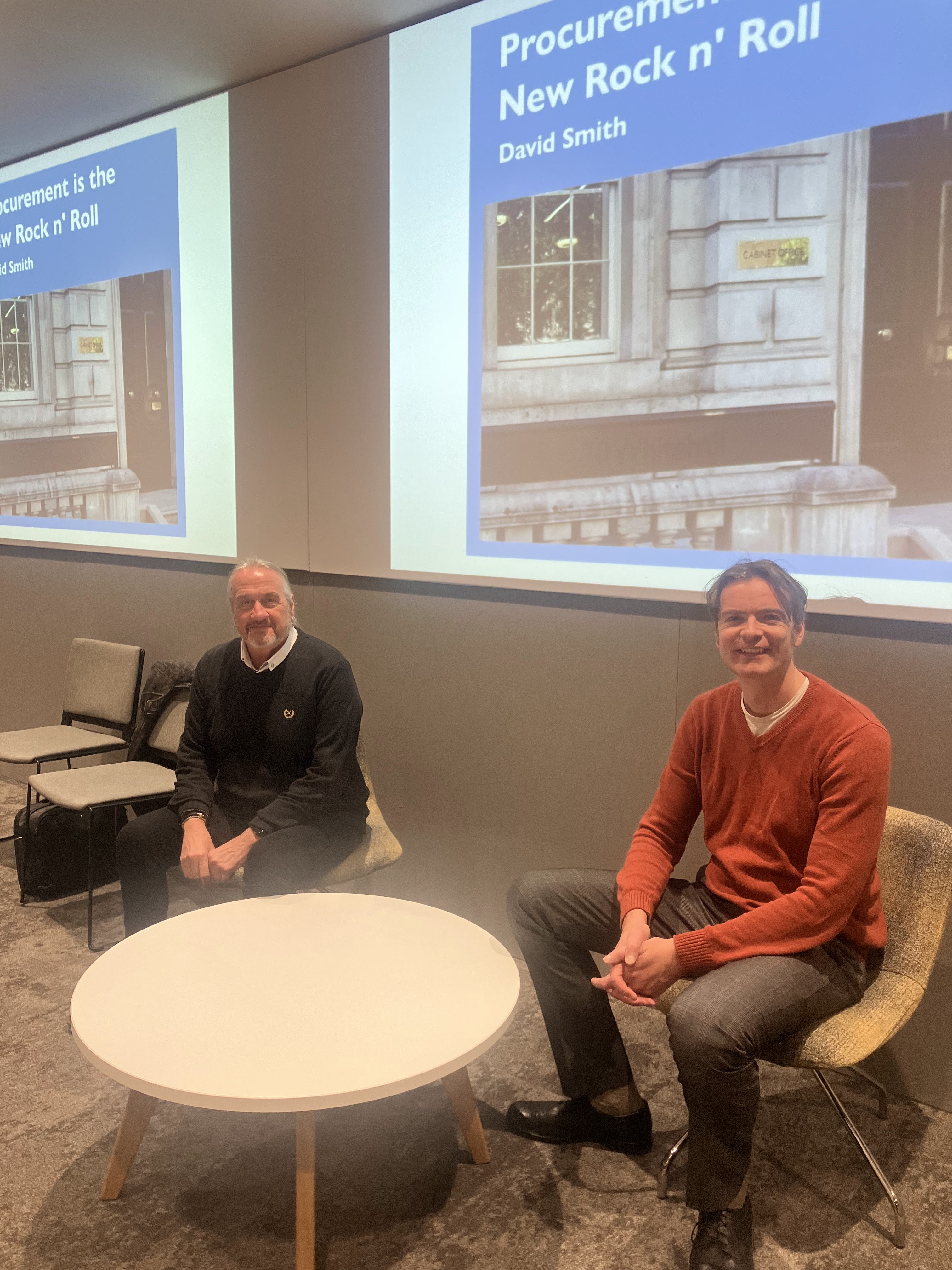
On Thursday 10th November Dr Alex Gillett hosted David Smith, CB, FCIPS, as part of the Public Sector Leaders seminar series at University of York School for Business and Society. David's talk had the title 'Procurement is the new rock n' roll'.


The talk mostly focussed on the history and development of Government Procurement and its professionalisation within the civil service.


The relevance to Soccer Mad Boffins is that David is a former football referee with the Surrey FA and he made some comparison between refereeing football games and overseeing procurement as part of the presentation.

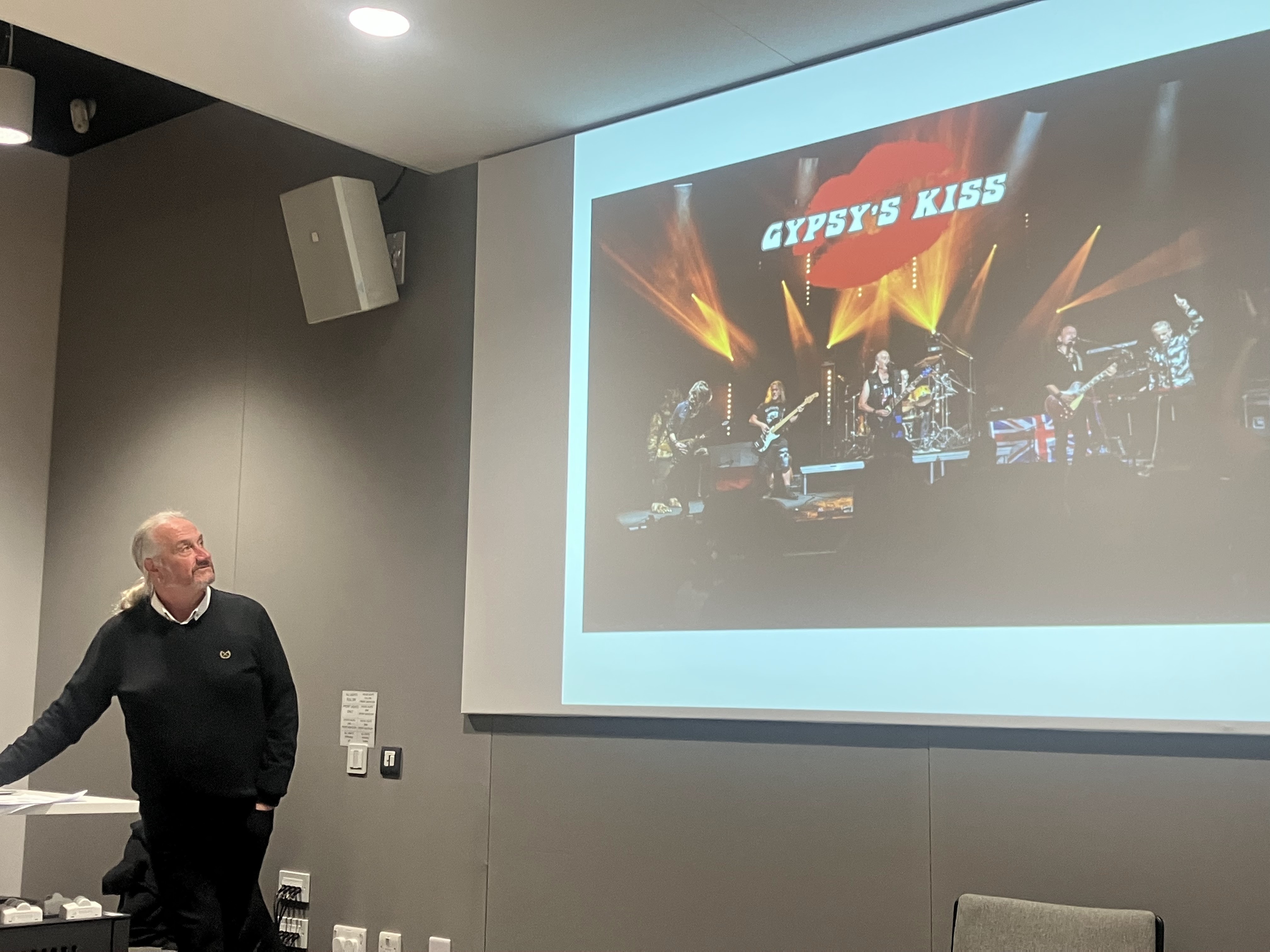
David is also frontman of the band Gypsy's Kiss, a forerunner of Iron Maiden, which reunited in 2018 to play live gigs with a new line-up based around David as an original member.  They have music on CD and streaming services such as Spotify, t-shirts and more: https://www.gypsyskiss.net


David gave a fascinating talk and afterwards took many questions from the enthusiastic audience. At the very end he presented Alex with a Gypsy's Kiss t-shirt.


Friday, 14 October 2022

Guest Lecture by Professor Jonathan Sullivan: 'China's Engagement with the Global Game'

Dr Jonathan Sullivan sits with Soccermadboffin Dr Alex G. Gillett. 

(Photo credit: Prof Neil Lunt)


On Wednesday 12th October, the University of York School for Business & Society proudly hosted Professor of Political Science Jonathan Sullivan, from Nottingham University.

The event was a lecture on 'China's Engagement with the Global Game', the department's prestigious Social Policy East Asia Exchange Workshop series.

We have previously reported on Jonathan's China Soccer Observatory which he leads alongside Professor Simon Chadwick. 

The guest lecture highlighted Chinese government policy towards developing football domestically and in the international arena. The talk, which lasted for around an hour, was followed by some excellent questions and discussion from staff and students, which Professor Sullivan answered in great detail.

The event was organised and attended by several of York's experts in social policy including Professor Neil Lunt, Professor John Hudson, and Dr Sabrina Chai, amongst others. Special thanks also to Eric Swales who also helped to organise and to promote the event.

We look forward to hearing more from Jonathan in future.


Monday, 7 June 2021

Euro 2020 (in 2021!) Predictions


With the covid-delayed Euro 2020 now finally just a few days away, we decided to follow soccermadboffins tradition and map out three scenarios: Kevin’s predictions, Alex’s predictions, and the predictions of a dice roll.


A quick explanation as to how the dice roll scores were calculated

-        If rolling a 1, 2, or 3 that’s the score, 
-        If rolling 4 or 5 it counted as ‘nil’, and;
-        Rolling a 6 meant roll again and use whatever number comes up (so the upper limit of normal time is 6 goals but it is fairly unlikely to come up).


So what are the predictions?

As usual at the end of the Group Stage we will show all of our predictions and those of the dice vs the reality.  If we can find them, after the group stages we will also try to compare with any algorithm type predictions as proposed by statisticians working for business consultancies and universities.

We cannot all get every prediction right, so we will then try to do another set of predictions based on who actually gets out of the Group Stages and as the knock-out rounds unfold.

But in the meantime we had a go at predicting the entire tournament…


Random Dice Rolls…


The dice interestingly predict England to finish 3rd in their group, behind Scotland and Czech Republic, then face North Macedonia in Budapest for a crunch Round of 16 fixture...which North Macedomia win 5-3 after extra time!

Also in the Round of 16 Scotland lose 2-3 to Germany in Dublin. 

Wales finish third in Group A behind Switzerland and Italy, progressing to a showdown with France in the Round of 16, winning 3-2 to become the Great British hope before folding to a 0-6 defeat by the Czech Republic in the Quarter-Finals.

Surprise breakout teams will include Finland, who will reach the semi-final. Also....

Winner: Austria to convincingly beat Hungary 5-1, to lift the trophy!

Austrian team celebrating...a realistic prediction for this year's Euros?


Alex

Predicts England to finish second in their Group, before crashing out to Sweden after a penalty shoot-out in the Round of 16.

Predicts Scotland to finish in third place in their group, just behind England, to reach the Round of 16 where they lose to the Netherlands 1-2 after extra-time.

Predicted Wales to achieve just 1 point to finish third in their group and fail to qualify for the Round of 16.

Winners: Germany to beat Portugal in a close final.

Germany is used to celebrating...could it be deja vu in 2021 and is it starting to get boring yet?


Kevin

England will win Group D before meeting France in the Round of 16, who will beat them on penalties.

Scotland will finish bottom of Group D and fail to progress.

Wales are to be Great Britiain's best hope, finishing as runners-up in Group A just behind Italy, then beating Denmark on penalties in the Round fo 16, before losing 1-2 to Portugal in the Quarter-Final. 

Winner: Belgium to beat France, also in a close final.

Could the Euros bring some excitement to Belgium?

**********************************************************************


Check back soon for progress reports on how our predictions (and those fo the dice) fare against reality! (and against statistical modellers such as at Economics Observatory).

Remember, these predictions are for fun only please do not use them as the basis for any gambling decisions!


The big kick-off is this Friday when Turkey play Italy. Wales play Switzerland on Saturday, England kick-off their campaign v Croatia on Sunday, and then Scotland line-up against the Czech Republic on Monday. 

To celebrate, we have a free online public lecture and Q&A with former FIFA-listed referee Keith Hackett. It will take place this Saturday 12th June starting at 2.30pm prompt. It will last for one hour and tickets are completely free, for more info and to book your place please click here.

Friday, 15 May 2020

World Cup Animation Featuring Our Book

Our book "Foundations of Managing Sporting Events: Organising the 1966 FIFA World Cup" is featured in a new animation available on Youtube entitled "How North Korea and Middlesbrough Became Unlikely Football Friends".

The animation, which lasts around 8 minutes long, tells the story of Middlesbrough and North Korea's unlikely friendship, which begins at Ayresome Park in 1966.


The video was produced by Tifo football, and the script was written by Dr Tosh Warwick of Manchester Metropolitan University. It draws from Dr Warwick's own excellent research on the 1966 World Cup, and a comprehensive review of literature relating to the tournament, including our book, which the film describes as "groundbreaking".

Pak Doo Ik's winning goal secured the Asian minnows a place in the quarter-finals of the FIFA World Cup. There, a curiosity developed in the Middlesbrough locals, after initial disinterest in the team, and the lowest recorded match attendance in the tournament. What evolved over the games, however, was a connection that warmed the hearts of many and one that has continued into the 21st Century.


Check it out by following this link: https://www.youtube.com/watch?v=h5M7Xf3HwAs

Wednesday, 28 August 2019

Financial Troubles at Football Clubs: York Festival of Ideas, and the cases of Middlesbrough, Bury and Bolton


Back in June it was our great privilege to present our research at York festival of Ideas.

We were involved with two sessions - the first, Chaired by Kevin, was a highly insightful presentation by Daniel Geey - a legal/business expert with significant experience in the football industry and has worked on a variety of club takeovers, high profile transfers, commercial endorsement deals and disputes. His talk centered around his book and was entitled 'Done Deal: Premier League Big Business' and generated much discussion from the audience about players, their agents, and tax issues - and some were also interested by the ethical implications that can arise. Thanks Daniel for a truly insightful presentation.


Next, we were both in conversation with best-selling investigative journalist and author, David Conn.


The event was notable for several reasons.

Firstly it was a first public appearence by Alex after experiencing serious illness earlier this year. Although he sat down for most of the event, getting out and in front of an audience was a big step forward in his recovery.

Secondly, sharing the 'stage' with David Conn was a real accomplishment.  On a personal level it was great to talk to him about our research, which has drawn on some of the facts an  ideas outlined in his books, particularly 'The Beautiful Game: Searching for the Soul of Football'.  Coincidently we were also undertaking our own research of the World Cup (and related to that, the history of FIFA) at around the same time as David was doing his own research, albeit more concerned with criticisms of the organization in its more recent form, and ultimately published in his 2017 book ''The Fall of the House of FIFA'.  


The talk began by Kevin outlining the work we have published, particularly the ideas of Shadow Hybridity and the Institutional Logic of Professional Sport, as outlined in our recent paper featured in Journal of Management History: 

Final published version (look it up via your university library): click here 

Accepted penultimate draft (unformatted document, freely available with no paywall): click here

Alex and Kevin then made links between our theories and the ideas presented in David's books about finance in football, and contrasting cash-strapped lower league teams, such as Middlesbrough in the mid-1980s with, premiership today's giants such as Manchester City and the concentration of wealth resulting in ever widening gaps between them and many teams of the lower leagues.

David responded passionately with detailed answers - he really cares about the subject matter - and has researched it thoroughly.

The things that we talked about that day struck a chord with the audience, many of whom had question and insightful comments to make about their own perceptions and experiences as fans.  

As some of you reading the will know, David Conn is a former student of University of York, the venue and a main organizer for the festival of Ideas.  After the event we took David for a walk around his old campus and enjoyed talking about the place.  Thanks David and also thanks to everyone at the Festival of Ideas team and the University of York for hosting our event, and to everyone who attended on the day for being a brilliant audience. Both of the football talks were free to attend but fully booked, so see you again next year, we hope, but book early!


David Conn revisits University of York (photo credit: Alex Gillett)


                                                                           ******


Reflections on Today's News

The last couple of days have brought these issues back into focus and our ideas about the institutional logic of professional sport have never seemed more pertinent, with Bury today being expelled from the league and Bolton Wanderers hanging on by a thread.  Two clubs with much history, including famous FA Cup wins.  

As Bury and Bolton, once proud Lancashire towns, have been consumed Pac-Man like by the 'Greater Manchester' metropolitan area, their economies as well as their football clubs appear to have declined financially, if not always so on the pitch (Bury were only just promoted this summer and Bolton have for many years been a bit of a 'yo yo' team but tend to pivot around the second tier)- whilst those of the dominant geography (ie the city of Manchester) have experienced what seems to the outsider to be a concentration of inward investment, and glory (United and City are both now globally recognized brands- and City won a clean sweep of domestic honors last year). 

Even Salford, a former dockland area (in the shadow of Old Trafford in one direction and the National football Museum in another) but newly revived by the arrival of the BBC at 'Media City' in 2011, now have a team competing professionally in the English Football League.  

Salford City FC is  buoyed financially by a consortium ex-Manchester United players' who seemingly preferred to 'start from scratch' and begin a new generation by taking a non-league club (as it was when they invested) into the league (where it is now), rather than take on the baggage of an established local league club with an existing fan base, but also the weight of history and the albatross of debt.  

For example the Neville brothers (Phil and Gary) have a combined ownership stake in the Salford Club of 20% according to Wikipedia - whilst by way of contrast their mother Judy worked as Bury FCs club secretary until recently, and their late father was at one time on the Bury FC Board of Directors (according to the BBC).  

As we outline in our paper, fans want to win and professional football clubs demand more and more money in order to retain their professional status.  Without constant investment and the promise of 'being in with a chance of promotion/winning the cup' will eventually lead to many paying fans deserting in their droves, and also lead to extra expense from 'sacking' managers, player wages and fees etc, to attract talent in the hope of turning things around. Maintaining professional status in order to be narrow the odds of achieving glory, creating a 'buzz' and attracting sponsors and television money, to re-invest in more players and stadiums seems to be the cycle of events time and again - only for some clubs that cycle becomes a death spiral, particularly if owners' laden more debts onto the club, for example by diversifying into sports halls/public gyms, hotels, or to subsidize some of their other business interests. 

We wish Bury and Bolton the very best of luck for the future, and hope that the precedents set by others such as Middlesbrough (which escaped by the skin of their teeth in 1986), and Accrington Stanley (which reformed after leaving the league in the 1960s - eventually returning in 2006 and now comfortably placed in League 1.)  

More closely to home we also hope that York City can capitalize on their strong start to the season and climb back up the pyramid soon.  It has been a turbulent few years for York and it would be great to eventually have League football at the new stadium when it is eventually opened.


Monday, 19 November 2018

Appearance at York Researchers' Night


On Saturday 17th November we participated in the 'Yornight' York Researchers' Night hosted by University of York.

This was a completely free event, no booking neccessary, open to the public.

Here is a photo of us on our stall, which included info about our research, examples of archival materials and ephemera, and some fun activities for all of the family.


We received a great deal of interest in our work on the organisational and business management history of sport, and our research methods.

As well as the soccermadboffins there were many other exciting stalls, displays, demonstrations and public talks from across the university.

Thank you to all who attended.


A young sport fan has her photo taken with our display trophy

The key audience for Yornight is the general public with a particular focus on school students, and young people.


The main aims of YorNight are:
  • To encourage young people to consider research as a career, and particularly to inspire young girls and women
  • To demonstrate how research improves our daily lives in a range of ways, and provides economic and societal benefits
  • To show that research is varied and unexpected, and that being a researcher is interesting
  • To convey the message to the public that researchers are everywhere, not just in the most obvious places eg laboratories
More information from:

Wednesday, 26 September 2018

Reflections on the 2018 Soccer Mad Boffins Conference Tour


What a summer! Amazing weather, a fantastic World Cup, and a veritable plethora of Soccer Mad Boffins public talks and academic lectures to fill in the time we weren't watching England progress to the semi-finals.  Here is a recap and reflection as we remember it...


June 1st 'England 1966, USA 1994 and the World Cup: Thoughts on populism, the popular and public indifference' 


Populism and the Leisure Spectacle: A BSA Leisure & Recreation Study Group Workshop 

Venue: University of Bath


This British Sociological Association workshop combined contemporary history with event management, cultural studies and theory with studies of national cases, the binding theme being the whys and wherefores of the populist profile of particular sport and leisure practices and cultural formations.

The event included presentations and panels discussion with experts also including Professor Alan Tomlinson, author/academic/broadcaster David Goldblatt, Michael Willams, and Brian Clift.

Soccer Mad Boffins' Alex Gillett opened the day with a consideration of the 1966 football World Cup finals tournament, hosted and won by England. Drawing upon his work with co-author Kevin Tennant he presented data on the almost serendipitous way in which the British government lent financial support to the event, the disappointment of those English regions beyond London for whom the anticipated tourist bonanza was a washout if not disaster, and the small scale of commercialisation of the product that nevertheless hinted at the later, media-generated and sponsor-based global commodity that the World Cup has become. The broader context was informed by Flyvbjerg’s four sublimes of the mega-project, to which Alex and Kevin’s research has brought an ethnographic and qualitative dimension as applied to the study of event history and business history. These themes and approaches stimulated lively discussion on just how we understand contemporary history and the lived meanings of iconic cultural moments in our past. He also looked at how the 1994 World Cup in the United States sought, through targeted marketing strategies aimed at both established and potential audiences, to popularize the game in the crowded US market dominated by the Big 4 (American Football, basketball, baseball and ice hockey).


June 12th 'The Business of World Cup Football'

co-presented with Greg Dyke (former Chairman of the Football Association)

Venue: York Festival of Ideas, The King's Manor, York


It was our great honour to co-present this event with Greg Dyke, which was attended by a large enthusiastic audience on a warm summer's evening.  We began by presenting from our research of the 1966 and 1994 FIFA World Cups contextualising it with information about more recent and future events, such as Brazil, Russia, Qatar and USA 2026.  Then followed a round table discussion chaired by Greg, who then reflected on his own experiences of being FA Chairman and Director General of the BBC.  The audience posed some excellent questions which we were delighted to answer and everyone enjoyed hearing Greg's views on football and its broader social impact as well as the business side. There were some predictions of England's likely performance in the World Cup which were superseded by Gareth Southgate and his team's performance in Russia!   Two days after the presentation, the 2018 World Cup kicked off. To tie-in with the event our podcast on the story of football was released and we hope to participate in the Festival of Ideas in 2019 - watch this space!  


June 20th 'Project Managing and Marketing the Soccer World Cup: 1966 and 1994'

Aston Organizational History Workshop

Venue: Aston Business School 


A few days after the World Cup kicked off we contributed to this workshop organized by Professor Stephanie Decker, Head of Research at Aston Business School.  This was a great venue because of its links to the 1966 World Cup and the event included several presentations covering a range of organizational history topics from manufacturing to finance.  We must add the catering was excellent - the samosas and cake were particularly enjoyable.  Over the course of one hour we presented findings from our paper accepted for the International Journal of the History of Sport as well as findings from our Project Management Journal paper and book Foundations of Managing Sporting Events.  Our research was very well received and we look forward to returning to Aston at the BAM2019 Conference where we will further develop the theme of our Special Interest Group, Management and Business History.


June 22nd Poster Presentation: 'Using Archival Research in University Teaching'

Venue: University of York Teaching and Learning Conference 


We made our first ever poster presentation on home turf at the University of York Teaching and Learning Conference.  Our poster was about archival research in teaching and served as an excellent warm-up for our appearance at the BAM 2018 annual conference.  See below!


July 9th - 13th Critical Acclaim for Soccer Mad Boffins!


With the World Cup well under way we were able to compare our predictions to reality which created some fun on this blog with several articles which went viral and even caught the attention of Soccernomics author Stefan Szymanski who described it as 'a teachable moment'.

This blog was also considered worthy of archiving by the British Library in the  UK Web Archive, which preserves specially selected websites that represent different aspects of UK heritage on the web, as well as important global events.


July 12th - 13th Management History Research Group workshop 


Venue: Riddle's Court, 322 Lawnmarket in Edinburgh


Arriving in Edinburgh we had the pleasure of watching England crash out of the World Cup in the semi-final in a pub full of Scotland supporters! A traditional Scottish deep fried supper helped ease the pain. The MHRG was a major success and the venue was fantastic as this photo depicts.  Our paper developed the poster presentation about using archives and was well received by a prestigious panel of professors.


September 4th-6th 'Management and Business History Track' of the British Academy of Management Annual Conference

Venue: University of the West of England, Bristol


The start of September took us to the historic port town home of Triphop, Banksy and the British aircraft industry. We opened the conference with a dinner in the former Bristol Stock Exchange, now an Indian restaurant. The ornate surroundings complimented the excellent meal. On the first day of activities we delivered a Professional Development Workshop on publishing academic books, drawing on our experience and expertise as editors of the Emerald series Frontiers of Management History. We met many impressive and creative new authors and hope to work with at least some of them soon. On Day 2 we presented a full paper version of our work previously presented at the MHRG and University of York poster session (see above).  By now we had used the constructive feedback to craft a developed paper which we hoped to publish.  Our thanks to the esteemed audience for all their comments and suggestions.  In our roles as Special Interest Group committee members we were also involved in chairing sessions and mentoring early career academics and we thoroughly enjoy contributing to the development of our academic field.  The main conference dinner was held at Aerospace Bristol where we got to walk through Concorde and enjoy the Concorde museum then enjoy a selection of wines and food courses at a table situated underneath the aircraft, whilst listening to Jonathan Dimbleby perform an on-the-couch interview with Micheal Eavis the promoter of Glastonbury Festival.  We were pleased that BAM brought a bit of aeronautic and creative industry business histories to the heart of its conference!