Showing posts with label Olympics. Show all posts

Tuesday, 23 September 2025

New Book Out Now: Foundations of Managing British Olympics


It has been some time coming, but the first of our long promised books on the Olympics is finally here!

Foundations of Managing British Olympics: Institutions Through Time charts how the British contributed to the development of the Olympic Games as an institution, and how they did this through the development of competitive sport through the nineteenth and early twentieth century.

This intriguing new volume tells the story of how the first modern Olympic revival happened and the role that British sporting movements and administrators played in its success. The book takes the reader from the earliest Olympic revivals in England to London being awarded the hosting rights for the London 1908 games.

To do this we drew on a broad range of research materials - among them archives belonging to the IOC, the British Olympic Associaton, FIFA, the National Football Museum, the English Amateur Atheltics Association, the collections of Lord Desborough, and numerous newspapers.

This volume will be of considerable interest to research academics working on aspects of 19th and early 20th century British, European and World History, including sport, social, business, management, economic and political history.

It is out from today in print direct from Emerald or your favourite bookseller - or also as an eBook or ePub.  Ideal for Christmas, or if you work or study at a universiity perhaps consider getting your academic library to subscribe to the electronic version.

This book is the latest in our series Frontiers of Management History which focuses on new and innovative histories. If you have a book idea connected to the history of business, management or organizations then please get in touch with us.

This is not the last we will do on this topic - watch this space for future releases!

Tuesday, 2 August 2016

Rio 2016 kicks off!

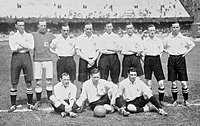
Great Britain's Gold Winning side of 1912
August is upon us, and the next Summer Olympic games, in Rio de Janiero, Brazil, officially starts on Friday 5th August with the Opening Ceremony.  The Summer Olympiad now contains 28 sports, with numerous sub-disciplines contained within, but an often overlooked yet historically important part of the games is the soccer tournament, held simultaneously for both men and women.  The soccer tournament will start on Wednesday 3rd August with Women's first round games between Sweden and South Africa, and Canada and Australia.

The men's tournament, officially first held at White City Stadium at the London 1908 Games is historically important because it was the first truly international soccer tournament to take place between teams representing individual nations, except for the British Home Championship, which had been contested since 1884. The 1908 tournament saw Great Britain beat Denmark 2-0 to claim the gold medal - the Netherlands, Sweden and France also took part in the competition, France even entering a 'B' team in an era before participation rules were sharpened up.  The tournament became the de-facto World Championship until the establishment of the FIFA World Cup in 1930.  Soccer missed the 1932 Los Angeles Olympics but still remained a presence at later Games despite the IOC and FIFA not seeing eye-to-eye for many years about the detail of soccer's participation, soccer being a professional sport in most countries yet Olympic athletes being strictly amateurs.  A compromise was eventually reached for the men's event that each team was limited to only three players per team with an age of more than 23, disqualifying most 'star' players from taking part.  As a result the women's tournament, which was only established as late as 1996, now in reality takes precedence, with current World Cup holders and five times gold medal winners the USA favourites to maintain their grip on the event.

Given the England women's good performance in the 2015 tournament in Canada, the non-inclusion of a Great Britain side at Rio 2016 due to the four British Football Association's inability to compromise on an Olympic team due to the fear of compromising their separate FIFA memberships seems particularly unfortunate. Despite being the inaugural gold winners and wining gold again in Stockholm in 1912, Great Britain has generally not taken part in the Olympic tournament or only sent strictly amateur teams for much of the tournament's existence. The main notable exceptions have been when London has hosted the games, in 1948 and 2012; in 1948 Great Britain, managed by Matt Busby, reached the semi-finals. In 2012 the men predictably plunged out in the quarter-finals on penalties to South Korea, the women suffering a similar fate being beaten 0-2 by Canada also in the quarter-finals.  Mexico and the USA would be respective champions.

The 2016 tournament promises to be an exciting one, especially in terms of the USA's grip on the women's game - we look forward to it!

Tuesday, 18 August 2015

Soccer Mad Boffins Summer World Tour

Following our success at the University of York CEGBI/CSWL summer conference (see previous post) - we have in recent weeks also had our research on referees discussed in the 'Uses of the Past: History and Memory of Organizations' Professional Development Workshop at the Academy of Management (AoM) in Vancouver, Canada.  Here we discussed the ethnographic character of the archives generated by referees as they travelled around the world, and how we can use them to document the development of refereeing as a profession.  Vancouver is of course fresh from hosting the final of the FIFA Women's World Cup and FIFA signs were still on display!  Kevin also visited the Olympic Village from the 2010 Winter Olympics, perhaps one of the better legacy sites from an Olympics. This is the second Olympic venue visited by a Soccer Mad Boffin this year.  Alex visited the Barcelona Olympic Venue and village in January.

Next month we will be attending the Management and Business History Track at the British Academy of Management (BAM) in Portsmouth, where we will discuss the findings from our 1966 FIFA World Cup Project. We are working on bigger plans for outputs from this, so watch this space!